Showing posts with label resource. Show all posts

Thursday, October 19, 2017

The Master Guide to Drawing Anime: Mostly Adorable


The Master Guide to Drawing Anime is more than just a pretty picture book. It is a good introduction for the beginner artist on how to draw in the manga/anime art style!

I'm always surprised when I read "how to draw" books and find useful tips in them to improve my drawing skills. You may find this silly, but I rarely read these books. I tend to use only half of the reference— the visual half— to add details to my own work. But the written half is incredibly useful as well. It tells you what you might not have picked up from the pictures alone: how and why the image works.

Christopher Hart delivered a good guide. In this book, Hart demonstrates "how to draw original characters from simple templates." The text accompanying the images is concise, but pertinent. He points out how small changes can make a big impact on your image. And all throughout, these changes will have a bearing on the character you create. That was probably my favorite part. Redrawing a character to look the same through a series of poses, actions, and outfits is difficult, so I'll take any help I can get with that. This focus on creating characters and keeping their looks consistent through multiple images makes this guide a wonderful reference for fledgling comic book artists. However, I wouldn't refer to this as a "master" guide. The book is split into six parts: schoolgirls, schoolboys, preteens, charming villains, humor in anime, and fantasy characters. Of these six, the bulk of the content is in drawing schoolgirls.

I guess drawing girls is more fun than drawing boys?
Maybe? I have a lot of fun drawing girls and women in a manga style, but that doesn't mean I wouldn't like to include boys and men in my drawings. I just found it odd how many more examples were available on how you could radically change a character type/personality (with a quick-change of hair, clothes, or expression) for girls than there were for the boys. And the schoolgirl section was the best illustrated and most informative section of the book also, with the preteens chapter being a close second. Perhaps Christopher Hart just loves drawing schoolgirls and preteens more than anything.

Are you saying—?!
Nothing pervy, you perv! All I'm saying is that those sections of the book received the most amount of love.

When you say love...
I'm saying detailed descriptions, variations, and full-color images for certain chapters and not others. If you do anything creative, there are certain things that you prefer to do over others. Given the attention to detail on these, I would say that "charming villains" are not on Hart's list of favorite things to draw. There were only two types: both male, based on the same body type, and they weren't even done in color. They were boring. The fantasy section of the book was a little longer and contained color images, but little variation. Furthermore, those drawings were all female and they all had essentially the same facial expression.

Overall, I feel as though Hart's enthusiasm and passion extended to only the first half of the book— a little like my enthusiasm for this review. The second half was "serviceable," at best. With the exception of the villains section, I enjoyed the artwork, and the tips on keeping character consistency. Depending on where you're at in your drawing skills, you might find this useful. But it isn't a "master" guide, or anything close to a definitive one.

One last thing to note before I go: After puzzling (loudly and repeatedly to my husband) over why the style of the art varied as much as it did from one section to the next, he pointed something out to me. This was not all drawn by the same artist. There were multiple contributing artists, and I don't think Christopher Hart was even one of them, though he did write the book.
So there you have it! My opinion hasn't changed much, but my jokes make less sense now.
Thanks a lot, Christopher Hart.

Friday, January 13, 2017

Celtic Spirit Coloring Book


You have to ask yourself just one question before you decide to get this book. Do you like intricate, Celtic knotwork? Well, do you? I know I don't! (Or at least, I don't care about it.) But I knew that going in, and I'm certainly not holding it against Celtic Spirit Coloring Book that knotwork just isn't my thing. That being said, if it's your thing, then congratulations: I found you a cool coloring book!

Maybe, like me, knotwork isn't really your thing either. That's okay. There are still some neat things for you in Celtic Spirit. There are 78 intricate images in this book, including some that are two-page spreads. Each image is a labyrinth for your colored pencils to get lost in. At times, I've found the images overwhelming! I have a tendency to try shading every little thing in the images I color. Almost nothing gets a flat color in my coloring books. But with this, I find it difficult to imagine coloring it any other way. How could I possibly keep up with my color scheme unless I pick my way from one end of the knot through its many loops, swirls, and tucks until I've completed it through to the other side? Again: not really my thing— but I can see how that could appeal to some people. If you're willing to get lost in that maze, I can see how this might be meditative for you. My favorite images have a nice balance between tiny, tight knots and the bigger, looser knots. These happen to include some excellent animal imagery, including dragons. (I know, what a shock: I like dragons! GASP!)

Finally, let me tell you about the paper itself: looks standard. The pages are thick enough that I think they may hold up to markers, but not to too many passes. Unfortunately, I can't test it, since this is a gift for someone. I'd stick to my colored pencils for it if this were my copy. The introduction also suggests that if you're particularly pleased with your work, you can frame and display it— or even gift it to someone! Of course, you could do this with any of the pages you color in any coloring books, but other books make it easy to do. This one does not. The pages are double-sided, and they are not perforated. Get ready for some book surgery if you decide to excise any of the images.

Overall, I would say Celtic Spirit is a decent coloring book, and you have better than even odds of liking it. Enjoy!

Monday, December 26, 2016

Guitar Zero: The Science of Becoming Musical at Any Age


I don't know if I mentioned recently that I started teaching myself to play guitar and ukulele. I am hardly musical and have never played a stringed instrument before. However, that didn't stop me from borrowing my dad-in-law's guitar, picking up a few books on the subject, and pretending like I could be a guitar hero. That's actually where this book came in. Since I was at the library anyway, I browsed through everything with the word "guitar" in it, and this sounded like something that might help a complete novice get started.

Unfortunately, I was wrong. The book isn't written to help the complete novice learn how to play the guitar. It's actually partly anecdotal pep-talk by author Gary Marcus— on how after years of sucking at all things musical he finally learned how to play guitar— and partly about the neuroscience that allows any of us to be musical at all. Since I am a fan of neuroscience, I was not completely disappointed by the lack of instruction in this book. It runs long for a pep-talk, and the gist of the brain science is this: There is no music-specific region of the brain, and practice makes perfect. That's pretty much it. I'd love to give more explicit details, but unfortunately it's been several months since I read it and I've already returned the book to the library. ... Oops. On the bright side, I can't really spoil it for you!

So this may seem pretty obvious, but you may be interested in this book if you are passionate about music and brains. I know a couple of people like that, and I'm sure that more exist. Personally, I just wanted an instructional book.

Saturday, October 8, 2016

The Food Lovers Make it Paleo Cookbook

You see? I'm not the only one who thinks so!
Is there any word in the English language more frightening than "Diet?" Especially at this time of the year, when one of our greatest pleasures as Americans is to dress up in costumes all month long and stuff our faces full of delicious sugar? Perhaps. But "diet" remains one of my least favorite words, capable of causing haunting nightmares.

Privileged much?
Yes, but that's not what this post is about. It's about a cookbook that doesn't even make mention of the word "diet," which is one of the reasons I like it so much.

That was an unexpected turnaround!
Yes, thank you. Before we move on to the actual book review, you should know something about me: I don't really cook. I know a few recipes by heart— they're simple, straightforward, and will feed me for the better part of a week with only thirty to forty minutes of effort on my part. I like these recipes because I am a lazy cook. I've also already practiced eating Paleo(ish) before. It is also fairly straightforward, but even a lazy cook gets tired of eating the exact same thing on a daily basis.


The Food Lovers Make it Paleo cookbook contains "over 200 grain-free recipes for any occasion." Not all of them are made with the lazy cook in mind, but I'm happy to report that not one of the recipes made me think I needed to be an accomplished chef to make them. The recipes are formatted so that— at a glance— you can see: the ingredients you need, the process to make them, difficulty, estimated prep and cook time, and how many people it serves.

As with many cookbooks, the recipes are separated into different meals (breakfasts, appetizers, entrĂ©es), as well as side dishes, sauces, and treats. This makes figuring out what you want to eat the following day especially simple. Feel like changing up your breakfast routine? Go to the breakfast section! Is your favorite thing in the world chicken but you want to change up the side dishes for dinner? Go to the side dishes section! What if you tried one of the recipes, and maybe you weren't a fan of most of it, but hot DAMN! That sauce that you had on it was the best thing ever and you could drink it by the gallon? The sauces are in a separate section. You can find most things quickly in this book.

What if nothing in my kitchen is set up for eating like a caveman?
That's okay! If you think you'll be making many of these recipes, it may be a good idea to rethink what you stock in your cabinets. None of the ingredients needed are necessarily difficult to find, and there is a chapter devoted to "the Paleo Kitchen." Therein you will find what authors Staley and Mason recommend as key ingredients to keep handy in your kitchen, tools to make your life easier, and "basic cooking tips" (for people like me who know only the most basic anatomy of the stove).

But how will I know what's good to eat? Isn't that what REALLY matters?!
Generally we're not supposed to eat with our eyes, but since I cannot know what a recipe tastes like until I make it, I go by the pictures. Make it Paleo is beautifully illustrated, and everything looks delicious. And if you're not sure what to pair together for an amazing meal, well they've got you covered there also with some suggested menus for special occasions!

You might like this book if:

  1. You're already a fan of the paleo lifestyle and you want additional recipes
  2. You're looking to improve your health by cutting out some common processed ingredients.
  3. You like food.
Sorry guys, I really can't think of a reason you might not like this book. Unless you're completely vegetarian or vegan, in which case half of it might not apply to you.

Saturday, September 17, 2016

Hello, Bicycle: A love letter on two wheels

Mango and I went to the e-cycle place in town to get rid of an old scanner,
then treated ourselves with a trip to the library!
My husband spoils me: for my birthday he bought me a shiny new bike. Though I originally intended to get a folding bike (for easy storing and getting around town), the folks at our local bike shop pointed out this beauty and I fell in love with it. I call her "Mango," and I take her out for rides as often as possible. Though Mango and I are probably in the honeymoon phase of our relationship, it is clear that Anna Brones and her bike are not. She obviously has a deep, abiding love for her two-wheeled conveyance. Hello Bicycle is clearly her love letter to bicycles with added useful information to their riders.


You are a woman of strange passions...
I am a woman of varied passions, that's all. And bicycling is now one of them! I requested Hello Bicycle from Blogging for Books— in exchange for an honest and fair review, of course— because it promised a "practical guide to the bike life with real-world advice" which I hoped included how to fix a flat tire. Honestly, I wasn't sure what to expect beyond that, and I was happy that I got it! I suspect Anna Brones is a woman of varied passions as well, since she includes more than just bike history, maintenance, and various reasons you should dust off your bike and get pedaling. Were you wondering what you could do with a bicycle beyond going for a joy ride? Ultimately we ride because we want to and it's enjoyable, but had you considered other possible biking adventures like camping, touring, or just commuting? And how will you remain fueled? Brones includes snack recipes to keep you pedaling, gear that might make your life easier if you want your two-wheeled steed to be as utilitarian as possible (or you want to go touring), and even up-cycle projects you can do when you inevitably get a flat tire (or two) and can no longer patch the tubes in your tires. All of that and more in a short book that you could read in an afternoon!

Overall, I would classify this book as a good, beginner "bike info sampler." You can tell with every sentence that Brones loves her cycling. She gives compelling reasons to add cycling to our everyday lives, as well as points out how easy it would be. If you haven't been on a bike since you were a kid, but you want to get back into it: this would be a good book for you. You'll get help figuring out what you need in a bike and additional resources to check out. If you're looking for something with more technical jargon, move along.

Saturday, August 27, 2016

A is for Adventure: Part Coloring Book, Monster Manual, Campaign Guide. ALL Fun


The other day, I went on a little shopping spree for my friends. I am not allowing myself to spend much on myself lately, but I wanted to get a few little thank you gifts for my D&D group so... I bought coloring books. Of the three that I bought, my absolute favorite is A is for Adventure, by Scott Aleric. I want this book for myself and I want it now.

So the artwork is good?
Yes, but that's not all. This book is fantastic! I appreciate Aleric's style and the attention to detail. All the monsters are displayed in dynamic poses— typically in the process of mauling some foolish adventurer. The illustrations are worked in ink with full backgrounds and— Okay, you may find this a little bit strange, but...

I've read your other reviews. How could this be any stranger?
—what really does it for me is the hatch and cross-hatch shading. I love the texture it creates on the page. It's something that I just don't see all that much anymore, especially as more artists do digital art. And I haven't even told you about my absolute favorite part!

There's more?!
Yes! Included with each letter/monster is a mini campaign scenario featuring the monster, a small map, and even some plot twists to kick things up a notch. What I particularly love about these adventures is that they act almost as adventure-Legos: you could play with them on their own, put them together, or drop it in to your bigger campaign set. Tweak the scenarios to taste! Overall, I highly recommend this book! You'll like it too if you're into: 
  1. Coloring! The pages are thin, but single-sided. No worries about markers bleeding through to the next page.
  2. Role-playing! Mini campaigns need little customization if you're a lazy dungeon master or you just want to sample playing with friends.
  3. Monster art! Most of the illustrations look like the monsters are winning. That's typically a plus in my book!
Have fun!

Tuesday, August 2, 2016

The Rooftop Growing Guide


Another gardening book?
Yep! I'm pretending to be a Sim, in the hopes that reading enough books about a subject will transform me into a master gardener before I ever touch dirt. Remember, I'm also working from a disadvantage: ignorance in gardening presents itself first as a black thumb. At least I'm hoping it's my ignorance of proper gardening techniques that murders the plants, and not a genetic predisposition to screwing up green spaces. 

Originally, I ordered this book to help me with my container garden, because obviously a rooftop garden means a container garden on the roof. At least, that's what I thought. I was pleasantly surprised to learn that is not always the case! It should've been obvious to me from the title and picture on the cover, but Annie Novak meant nothing so small as a container when she wrote this book. After all, look at the flat roof on that building and the size of the plants atop it!

I think this book is aimed primarily at people living in dense urban zones where there aren't many green spaces. Basically, since real estate is scarce and high cost, they instead turn to their roofs. It makes sense, really. On the roof of a building, you don't have to worry as much about whether your building or the next is perpetually casting shade over your plants, or if you have enough space in your tiny backyard to plant all you want. What if you want to plant something in particular, but the soil conditions in your area are not optimal for your new green darling? Rooftop gardening is the perfect opportunity to create your own optimal growing settings.

If only it were as easy as seeds + dirt + water. My strawberries
refuse to grow, and it makes me sad!
Before you get to thinking that it's as easy as throwing some dirt on your roof and some seeds on top of that, let me just tell you: No, not quite. It is still gardening, but with a few twists! These include whether or not your roof can even properly support a garden! Let's face it, buildings are made to sustain a certain amount of weight. Soil, plants with their roots, and especially the water intended to make everything grow, is likely to add weight the building may not support. That issue is fairly straightforward, but also stop to think about how you'll irrigate your rooftop garden, or how the roof microclimate will affect your plants! Yeah, I went there: I said "microclimate." No, rooftop gardening is decidedly not as straightforward as tossing some dirt and seeds up there and hoping for the best.

At this point, you're probably wishing I'd just get to the point and tell you how it would benefit you to get this book. First and foremost: Do you have a flat roof to grow things on? If you do, you will find this book interesting and helpful, whether you intend to have a small herb garden or a full-blown farm. The writing is engaging, and Novak has anecdotes from other rooftop gardeners to augment her own knowledge. Chances are that if you have a question, she will likely address it or has some other resource to offer. She covers topics ranging from assessing your rooftop —can I even grow here?— and pests, to choosing whether to grow in containers or greenhouses, or green roofs. And of course, there is also the ever present chapter on planning your garden. Yes, if I've learned anything from all these gardening books, it's that besides remembering to actually water your plants, the most important thing you can do is to plan your garden.

However, since I do not have a flat roof on which to grow things, I found The Rooftop Growing Guide to be theoretically interesting, but ultimately impractical. A more general gardening book would have suited me better, but that is not Annie Novak's fault. So if you have a flat roof, I absolutely recommend this book. And if you don't, you might still find it interesting to read.

I received a complimentary copy of The Rooftop Growing Guide from Blogging for Books in exchange for a fair and honest review.

Thursday, July 14, 2016

Edward's Menagerie: Birds!

My youngest brother loves birds, and I love making things. So when I came across Edward's Menagerie: Birds by Kerry Lord on Amazon and saw that they were having a book sale, I made a deal with my dear bro. If he got me the book for Christmas, I would make him a bird for his birthday. Well, he kept up his side of the bargain, and I became the proud owner of this avian themed collection of patterns. Then, of course, my schedule blew up and I've yet to start the toucan I promised him. His birthday was four months ago.

Worst. Sister. Ever.
Yeah, I know. But he'll get his toucan! I just hope he names it something more interesting than Kerry Lord named hers. All of the birds in this book have their own names and little bios stuffed full of personality. It's disgustingly adorable, for the most part. But then you get to the toucan, and the description was so prissy it actually turned me off to the entire pattern. Since all of the patterns have little bios, though, I think this could also work as a little children's book. Not the kind that you hand to itty-bitties to tug on, but you could read it to them and show off the pictures. Or, even better, make the toy and then tell them the pre-made story behind it!

Beyond that, there are some things you should know before you go out and buy this book...

  1. All the patterns are written with European abbreviations. I know this is a deal-breaker for some people, but the European abbreviations don't make it incomprehensible. Additionally, Lord even points out in a couple of sections what the U.S. equivalents are for what she's talking about.
  2. The birds are sorted into three levels of difficulty, so if you're a complete beginner you can start at level 1 and if you feel the need for a challenge you can jump to level 3. I think you could make all the patterns with only a little experience and some tenacity.
  3. The patterns are split in different parts throughout the book: standard forms, levels 1-3 birds, and technicals. So if you wanted to make Ina the Stork (level 1), it bids you to start the body, neck, head, and wings from the standard forms. The pattern for the legs and beak are on the same page as Ina's bio. To put it all together, you would refer to the "technicals" section; that covers all the additional little details.
  4. Of the 40 patterns listed in the book, there are 3 distinct: owls, penguins, and chickens. Think about that. You don't just get an owl, or a penguin, or a chicken. You get a barn owl (and 2 other subspecies buddies), an emperor penguin (and buddies), and a silkie chicken (plus a regular hen and a rooster). That's just cool.
If you appreciate birds, attention to detail, and some realism in your toys, I would highly recommend Edward's Menagerie: Birds. Even if you're a complete beginner, you can find something here that would be satisfying and fun to make. The patterns look solid, and the directions for all of the toys are "baby friendly" (none of them use extra little bits like buttons that babies and younger children might choke on). As always with crafting books, I recommend getting the print version of this book— especially given how the patterns are separated in the different sections. So have fun with it, guys!

P.S.
I hope I'll have an opportunity to show off my brother's toucan soon, along with a blue-footed booby for good measure. Because how could I resist making a booby or two?

Sunday, June 26, 2016

Stitch 'N Bitch: The Knitter's Handbook


I suck at knitting. No matter how hard I try, I can't seem to go beyond the absolute basics— straight knitting needles and square shapes. That isn't for lack of trying, or lack of being informed, though. After falling in love with Stitch 'N Bitch: The Happy Hooker, I was sure that Debbie Stoller's original knitting handbook would be the perfect way to teach myself to knit! I wasn't exactly wrong... But my increased knitting knowledge has not helped me complete complex projects. And why? Because if this book has taught me anything, it's that I need five times the tools and a blood sacrifice to achieve what I could with one crochet hook. But let's pretend for a minute that you're already a knitter and are used to these blood sacrifices.

I keep sheep for this express purpose!
I would keep sheep for the eventual yarn but if you want to play it biblical and keep them handy for blood sacrifices, that's cool too, I guess. You do you.

So, you're already a knitter: Jump into the deep end with 40 knitting projects of varying difficulty! They range from quick scarves and hats to marathon-style, focus-heavy sweaters and blankets. There is even a pattern for a cat bed in here. I find that one amusingly pointless, since my cat would prefer to sleep on a pile of clean clothes or on my face over her own bed any day.

Tools of the trade: Crochet hooks (top left), circular knitting needles
(top right), straight knitting needles, and resource book.
The only thing I found frustrating (and this has more to do with knitting as a craft than with the book) is that I wanted to make some of these hats and they required two or three different types of needles. That means I would need to have between five and seven needles for one project. Is that Debbie Stoller's fault? Or the fault of the designers featured in this book? Absolutely not! I appreciate that they let me know beforehand so I didn't waste my time starting a project that I'd never finish for lack of owning every damn knitting tool on the market. But we're pretending you're already a knitter, so maybe you own all that already. Congratulations! These are some cool-looking projects! My favorites are the different bags. As I was flipping through the book again today, I got the itch to make all of them: backpacks, purses, and totes. They look complex, but are fairly straightforward to make. All patterns contained herein include a briefing on necessary materials, the gauge you should be aiming for, finished size, and best yarns to use. All patterns were screened by a technical editor as well, so they're pretty much guaranteed to work. I certainly haven't found any technical problems with them yet.

What if I'm a complete beginner?
Fear not! This is still a fantastic, beginner-friendly resource book. The beginning half of the book is dedicated to teaching you knitting basics and some additional niceties. One of the things I love about the Stitch 'N Bitch series is how in-depth it goes. While some books will attempt to teach you as they go along with the pattern, Stoller does it all up-front so you can try tackling those tougher projects after some reading. Even if you've never held a pair of knitting needles and yarn, she explains the process in a clear and entertaining manner. You could, of course, just read the portion on how to start your project and jump into the patterns. You can use this book however you damn well please. But I think you'll have an easier time if you actually read some of it first.

You know what else is pretty cool about this? Stoller mentions several different resources within the book to further educate yourself on the subject of knitting! She mentions multiple books, magazines, and websites for additional reading. If you want to shop for fancy yarns at discount prices, she points out the best way to search for them. This book is full of handy tips and tricks for getting the most out of your knitting experience. If you're interested in the craft, I highly recommend checking this book out. It can only make your life— at least the knitting portion of it— easier. Good luck, and happy knitting!

Tuesday, May 24, 2016

Stitch 'N Bitch: The Happy Hooker

Find me on Amazon in digital format!
My love of this book—

"Love," is it?
—begins with the title. Which, unfortunately, does not lend itself to my usual introductory snark, so I'll be skipping that today. Instead, let me just tell you about one of my favorite crochet books!

The Happy Hooker was my introduction to the Stitch 'N Bitch series by Debbie Stoller, as well as my reintroduction to crochet after many years of not practicing. I came across this title while perusing the craft section at Barnes & Noble many years ago.

Like a crack addict in the crack section of the store? What a surprise.
My name is Ly and I am a yarnaholic. My stash is so great that several months of dedicated crocheting have done little to reduce it. That being said, it is not for lack of trying or lack of patterns. If anything, maybe I have too many options. Debbie Stoller put together a collection of patterns from various designers that range from hats and scarves to purses and swimwear; an entire wardrobe just begging to be made. Not that I'm insinuating there are only patterns for clothes and accessories here. The book also includes: an outdoor rug, amigurumi, bunny slippers, afghans, and some baby things.

Happy Hooker is split in two parts. The first is the best and most comprehensive "how to hook" section of a crochet book that I have ever encountered. Even if I got bored of all of the patterns in this book— which is unlikely— I would hang on to it for use as a reference guide. If you are a beginning or returning crocheter and you're rusty on your basics, this book will whip you back into shape in no time flat!

Kinky hook(er), is it?
Creativity and knowledge of a few basic shapes turn a
basic beanie pattern into something extra special
More like best hook for buying and keeping a book! Most craft books will give you a crash course on the basics you'll need to know to reproduce the patterns therein, but this... This is comprehensive! I find that I remember things best when I understand how they work, instead of memorizing that they just work a certain way. Stoller explains the "hows" and "whys" of crochet, as well as delves into some of the history and the differences between crochet and knitting. The result is that after reading this, and a little practice with the patterns, I was able to start figuring out patterns on my own. This book has even helped me with patterns in other books. Do you have any idea how annoying it is to start a project, follow the directions exactly, and find that at the end, the directions didn't make sense for the thing you're trying to produce?

Is it awful?
It IS awful! But with a bit of knowledge, like that provided in The Happy Hooker, you may be able to figure out what went wrong and fix it yourself! I certainly have. I cannot stress this enough: this will help you break down patterns into their basic components. No pattern will be so complicated that you can't ultimately make it your bitch. That's how this book will make you feel. From how to hold your hook, to finishing your project, and everything in between: Stoller explains it all.
Part of making a pattern your bitch is making things up
when you can't find a pattern for it at all.

What about the patterns?
Part two of The Happy Hooker is broken up further into sections for: scarves and shawls, hats, bags, "spring and summer" (clothes), "Fall and winter" (sweaters), accessories, and "home, gifts and baby." The patterns are by different designers and I've yet to encounter one that didn't work the way it's supposed to. In other words, someone actually made all of the projects presented and edited the patterns accordingly so there are no mistakes.

You say that like not all editors earn their keep...
Because they don't always earn their keep. That is yet another point in this book's favor. Each pattern includes some basic information about the project: the finished size, different sizes (small, medium, large), materials, extras you may need, and special stitches you'll be learning. They have recommendations for the yarn you use or how to adapt the pattern if you decide to go with something else. I believe the patterns for scarves, shawls, hats, bags, and home things are generally the easiest to make, since gauge— though always given— is not always as important to adhere to. However, once you've gained some confidence in your hooking abilities, I recommend branching out and making yourself some clothes!

So basically, what you're saying is... You love this book.
YES! Stitch 'N Bitch: The Happy Hooker is my constant crochet companion. I highly recommend it to everyone, whether beginner or master hooker. I am an extremely happy hooker; you can be too!

A note about format:
I bought myself a Kindle a few months ago after years of believing that a digital format could never compare with the touch and smell of a paperback. While I sometimes miss the smell of paperbacks, I'm happy to report that my Kindle Paperwhite at least feels like a book in my hands, albeit much lighter. Obviously, whether you decide to go digital or physical with your books depends entirely on your personal preference but I do want to point something out. With craft books, there will be times when you'll want to check the reference section at the front of the book for help on something while you're working on a project and I (personally) think physical copies are the way to go in such cases. Just putting my opinion all over this blog, y'know. I recommend this book and —if you have the space for it on your bookshelf— I recommend getting a physical copy. That being said, I hope you enjoyed the review!

Sunday, May 8, 2016

The Water-Saving Garden: Because weather doesn't always happen in California


Fun fact: the state of California has every type of climate in the world except for tropical. Pretty cool, huh? That means if you travel a few hours in any direction, you'll find yourself in a different climate than where you started without even needing to leave the state. Unfortunately, for the last several years, we've been suffering through a severe drought. This makes me nervous: I've never wanted to live in the desert. My favorite color is green, not brown, and I love playing in water. So water conservation is high on my list of priorities. The Water-Saving Garden, by Pam Penick, is a book I picked up for free from Blogging for Books (in exchange for a fair and honest review), in the hopes of cultivating a kick-ass garden without wasting water. Let me tell you a thing or five about what I've learned...


The Water-Saving Garden is broken up into five different parts: inspiration, retaining water, planting, making you see things that aren't there, and recommended plants. That is a lot to pack into one book, but Penick does a great job of it. The inspiration portion features multiple gardens and highlights the different features that make them drought resistant. This portion is more photos than text, but it's a great way to start— giving you ideas as to what is possible.

My favorite parts in this book are probably the second part and third parts: retaining and planting. Basically: plan your garden. Before reading this book, I hadn't thought that planning a garden was more than deciding what plants to put in the ground or where I would place them relative to each other. That is certainly part of it, but you also want to consider how you can make it an inviting or relaxing space to be in, how you're going to water it, and how you can retain the maximum amount of rainfall on your property. Are you interested in holding rainwater to use during dry spells? There's a section for that in this book. What about preventing that rain from just going down the gutter and instead replenishing the ground water? That's in here too! I want to say that the basic premise of this book is: don't just reduce the amount of water you throw outside from your taps. Tap into the water that's already in the ground!

Thirdly, a chance to get dirty: Plant your garden!

So now you have a bunch of cacti planted in your yard so you won't have to water them?
Actually, right now I have a patch of dirt that needs to be cleared of debris. But to your insinuation that I would have a yard full of cacti I say, “Hah!” And no. While cacti and other succulents are certainly water thrifty plants, they are absolutely not the only choice available if you want to conserve water in your garden. You know what isn't really a choice in this type of garden? Lawns.

Lawns are the Humvees of the plant world —they're resource guzzlers, require a lot of time and maintenance, and don't look all that great anyway.

GASP! How can you say that about lawns?! It's the American way!
I know a lot of people picture a house with a white picket fence and a beautiful lawn as an integral part of the American dream but I think we can do better. There are other ways of doing things! And like it or not, the fact remains that during a drought, your lawn is going to wither and die because the roots just don't grow deep enough. They require a lot of water, you have to mow them frequently, they get weedy if you blink at them — they are just a lot more work than they're worth. If your main goal is to conserve water: lose the lawn. If you can't bear to lose the lawn, reduce it. If you decide to install artificial turf, lose my number.

Wanna tell us how you really feel about fake grass?
That's a post for a different day and a different blog. My point is that lawn is boring, lacks creativity, and takes a lot of effort for not much pay-off. There are alternative grasses and ground covers available to create visual interest, that thrive on less water, and give you an open green space if that's what you're after. There are wildflowers, trees, shrubs, and ground covers that are drought hardy. It doesn't have to all be about cacti or other succulents: we have options if we take the time to find them. I suppose that's the biggest deterrent for a lot of people having a garden instead of a lawn. You can set a lawn down and it looks like a lawn right away, but it takes more maintenance time later on. It might take you more time upfront to plan and set up a drought-hardy garden, but it will mostly take care of itself afterward. After all, it's meant to thrive on the amount of water that falls from the sky instead of you hosing it down.

What about this “making you see things that aren't there” section?
The section is actually about creating the illusion of water where there may not be any. This can be achieved by using stones, cascading plants, a simple water feature, etc. — anything that evokes an image of lakes, the sea, or other water by using plants.

The final section in this book is dedicated to 101 plants for water-saving gardens. Because like puppies, 100 just isn't enough. Gotta throw in that extra one.

And there you have it! The Water-Saving Garden: How to grow a gorgeous garden with a lot less water by Pam Penick is 223 pages of beautifully illustrated advice on how to grow a garden while conserving resources. If you have any aspirations toward creating an inviting outdoor space, I highly recommend it!

Thursday, March 3, 2016

Crocodile Stitch Fashions a.k.a Fancy Stitches

I would like to thank all of you for indulging my fondness for crochet, and all things related to it.
Find me on Amazon!

Fondness, or obsession?
I say "toe-MAY-toe," you say "tuh-MAH-toe." Or in today's case, you say "crocodile stitch," and I say "dragonscales." Yes, I use my imagination whenever I see or make anything using this stitch. I cannot understand why someone would name a fantastical stitch such as this after something like a crocodile. "Dragonscale" sounds so much more elegant! Anyway, I'm rambling—

Per the norm...
But you're still here, so let me tell you about this book! Last year, one of my best friends sent me on a quest. For her birthday, she said, she wanted a pair of "dragonscale gloves."
"I want you to slay a dragon, and use its carcass
for my gloves!"


"I've seen them on Etsy, and they're rather fetching! I know no one more capable of procuring these for me than yourself. Why, with your amazing skills, I know you could whip up a pair of these in no time!"

With flattery such as this, how could I refuse? So I ventured forth to the magical, faraway land of Joann's Fabric Store. My first task, in this multitask fetch quest, was to procure the patterns. That's where Crocodile Stitch Fashions, by Lianka Azulay, comes in! This book had caught my attention on previous visits to the store, and I was delighted to finally have an excuse to stop stalking it and give it a proper hello.
"Looking good, book!
You work out?"
Though I bought it for one pattern in particular, this book contains eight different patterns featuring the crocodile stitch. Some of the patterns are fanciful, others beautiful, and some are just bizarre— but all of them are fun to make!

Can I make these if I suck at crochet?
Mmm, kinda? Okay, maybe this is not for complete noobs. As with all new things, it takes a little getting used to before you get it down. All the patterns are listed as "intermediate." The crocodile stitch is comprised of two basic components: chain stitches, and double crochet stitches. That's it. You just do that over and over, layer upon layer, until you come up with something fabulous. Luckily, Crocodile Stitch Fashions provides full-color photos of the different steps to help you along, as well as a stitch guide in case you forgot—or didn't already know—the basic stitches. To be fair, it actually took me several hours of doing, undoing, and redoing my first few rows before I really trusted that I was actually doing things correctly.

So maybe you're curious about the book now, and you want to check it out. Here are some things you'll want to know going in:
  • This title includes patterns for two different kinds of gloves, three hats, one shawl, a neck-warmer (not quite a scarf, I suppose), and a hood. Two of the hats are, in my humble opinion, quite ugly. The gloves, hood, and shawl make up for it. All of those are downright gorgeous.
  • These are great projects to work on during "down-time." Waiting in line? Have a little spare time during your lunch? Crochet it up!
Self patterning yarn
And that's honestly pretty much all there is to it! I know, kinda short, but it is a short book after all. I hope you enjoy it! It's certainly worth checking out.

What about the multitask fetch quest? Getting the book was just the first part!
That's true! The second task in my fetch quest was finding the proper yarn to make the gloves! The patterns are fun, but finding yarn to use for them is not. All the patterns in this book require superfine, light, or sport weight yarn, and those are tough to find in your average craft superstore in colors other than soft pastels meant for babies. Be prepared to run out to a specialty store or shop online for your yarn if you don't see something you like at the store. Your options at Michael's and JoAnn's are limited. As luck would have it, my friend wanted gray/black gloves in changing colors. I couldn't find a "multi-color" yarn in only gray and black, so I had to improvise. Afterwards, it was just a matter of obsessively making and remaking the first few rows until I was certain I could do no better.

Which brings me to my final point about these patterns: It's going to take a while to finish any of these projects. A shortened pair of gloves can take approximately eight hours to make. And if you're lacking in time and/or patience, consider commissioning me for a pair! I've had some time to practice.

Friday, February 19, 2016

My Crochet Doll: A picture book with patterns


Check me out on Amazon!
Once upon a time, in a strange, faraway land known as "JoAnns Fabric Store," I came across a charming crochet book featuring a simple doll with practically no nose, no mouth, and a delightfully detailed outfit. Intrigued, I snatched the book off the shelf and flipped through its contents.
"Hello, Kitty," I purred at the pages, for clearly our no-nose heroine's name is Katherine, "Why don't you tell me about yourself?"
Having thus acquired several weird looks for the day and no verbal response from the book, I continued my monologue at home after purchasing My Crochet Doll. Sixty pages worth of photos later, I finally found the patterns Isabelle Kessedjian promised. Despite my potentially misleading title (in which you might think that a picture book with patterns is a bad thing), I am quite in love with this book! Sixty pages of pictures goes a long way in showing you what is possible before actually teaching you how to do anything.

But it does show you how to make things, doesn't it?
YES! Okay, this would normally be the point where I start showing off some of the stuff that I've made while using the patterns in the book.
... I have a small confession to make.
       I have owned this book for over a year, and have yet to make anything from it.

GASP OF HORROR!
Don't judge me too harshly, I beg you! Thing is that, for as beautiful as the illustrations are, and convinced as I am that the patterns are sound, there has been something deterring me from just jumping in and making a beautiful crochet doll of my own. The patterns use the European abbreviations for crochet. European abbreviations are a bit odd to my American eyes. How can you call a single crochet a double, and then expect a half double to mean-- Okay, maybe you're not as interested in my tech-gibberish at the moment. That's fine. Moving on! The second deterrent is that the yarn the author uses is a lighter weight than what I normally work with. I believe she uses a weight 3 (or sport weight), while I use weight 4 (medium worsted a.k.a The Yarn EVERYONE Uses). Ultimately, that's going to make the patterns come out a little different. I like making one just how the pattern says for my first try, to figure out any quirks beforehand. Then I go crazy with it, adding or subtracting details as I see fit. But no matter what I do, my end product is going to end up different or a bit off because I'm not about to go out and buy more yarn until I've finished with what I've got. And if you saw the size of my stash, you'd see that's going to be quite a long time.

Enough excuses! What can you tell us about the patterns?!
Well, do you like weird? If you're still reading this, I'm going to go with "Duh, I like weird."
Okay, so you like weird.
This book... has a pattern... to make underwear for your doll. Not even joking. Honest to goodness, you can make cute little undies for your amigurumi. You can also make: shoes, pajamas, overalls, a superhero outfit (which is ultimately why I bought the book), a fancy dress, tiny cakes, and many other things! It's freaking adorable! And that's not even mentioning all the different little accessories that you can add to your new playmate. Ms. Kessedjian also mentions how to make a variety of hairstyles using different types of yarn, from regular 4-ply to wool. She talks about giving your doll additional personality with bits of wire (perhaps adding glasses to the doll) and other scrap materials. The funny thing is that, despite my insistence on making the first doll be "just like the author's" to get a feel for things, the author actually points out that the doll in this book is hers and she highly encourages the reader to make their own. Change the color! Give her different hair, or some glasses, or a different outfit, or mix-and-match with what's available in the book and beyond! Go crazy with it from the beginning! The important thing is to have fun. At the end, what you've made will be your crochet doll.

So that's pretty much all I've got to say about that. I highly recommend this book. At least check it out. Just remember, the abbreviations are different in this than in a book from a U.S. author. That being said, there is a little section (as in most of these books) that goes over the technical aspects of crochet: what the abbreviations are, what they mean, how to make the stitches, and the difference between U.S. and U.K. terminology and what the heck they mean by each.

I enjoyed the format of the book. The illustrations were gorgeous, and it was pleasant to simply flip through the pictures first and then have the patterns at the end. This may not be the best book for the absolute beginner. I recommend already knowing your basic stitches (chain, single stitch, slip stitch, etc) prior to picking this one up because there are no illustrations demonstrating how to get that started or hold the yarn. You're going to be awfully frustrated if you don't know how to hold your yarn and you try just going at this. Well, who knows... You might actually be a prodigy. But for those of us who aren't prodigies, it can get frustrating if you don't already have an idea of what you're doing.

Some day, I may share with you pictures of My Crochet Doll... but in the meantime, I hope you have fun with your own!

Tuesday, December 15, 2015

Generation T: Where high fashion meets bum comfort!

T-shirts are an integral part of my wardrobe. They're soft, comfortable, and my favorite way of displaying fandoms and/or art. The problem I run into, however, is that t-shirts are generally not made for ladies with, shall we say, "ample" bosoms in mind. Or even just with ladies in mind.

Let me rant to you about clothes for a minute here. I know you can go out and get "girl tees" which are specifically designed to fit lady parts better than your average tees, but think about how those work. A guy's t-shirt with a cool design on it can run you anywhere from $5 to $10. Maybe, if you're shopping at Hot Topic and you see one that you really love, you'll spend about $20 (because you just have to have it). The same t-shirt made to fit women? $20. No, they do not have it for $10. If it is made to fit a woman better than it fits a man, it will cost more. How unfair is that? And what about the sizes? If guys are buying a t-shirt, the cost of sizes extra-small all the way through extra large is exactly the same. Once they start hitting that 2XL or higher, they get charged a dollar or two more. Well, sorry guys: if you're 2XL or higher, that makes some sense. After all, that is LOT of shirt and requires more material. Women's t-shirts work in pretty much the same way, except that they are made primarily to fit thin women. And even then, if you're a skinny lady, prepare to feel fat because these are essentially children's sizes. So sizes XS to XL are the same, and they start charging more from 2XL and higher. But it isn't really more fabric that's at play here. For example: I fit into a men's medium. I can get in it with no problems. It covers my boobs, my stomach, has a nice length to it; it just doesn't fit nice. It doesn't hug my curves or anything. In a women's sizes, I'm suddenly an extra-large. The 2XL would fit better, but I don't want to pay more money, so I squeeze into the smaller shirt. Does it fit better than the men's shirt? Sure. It hugs my curves, that thing is on me. Is it more fabric? NO! I didn't suddenly need more fabric because the shirt is 2XL, but I'll still get charged more. Yet it's the same amount of fabric! Maybe even less!

This is a long rant. I thought you were going to review a book?!
I am. I'm setting up context. Keep your shirt on. OR, take it off and alter it to fit your needs!

Nice segue.
Thank you. My point is, I don't like paying more for a shirt just because I have boobs. That's where Generation T: 108 ways to transform a T-shirt by Megan Nicolay comes in. I came across this book at a Barnes & Noble many years ago. At the time, I worked at a GameStop and we would receive promotional t-shirts constantly, but never in the sizes that we actually needed. They were always way too big, and never in women's sizes. Finding this book was like an answered prayer! It includes 108 different ways to cut, slash, resew or no-sew your shirts.

I can't sew!
So maybe it's not high fashion. But it could be!
That's okay, because you don't always have to! One of the things I pulled from this book that I do constantly is simply cutting out the collar to men's shirts I like. Men's tees always feel too tight at the collar, and by simply cutting it out I have made the shirt fit better and also look cuter. Sometimes, that's all you need to do. This book taught me not to be scared of using my scissors. Many of the projects also have "no-sew" alternatives. Maybe you like a corset-style shirt, or you want to cinch up the sides of your favorite tee, but you don't want to sew? No problem. Instead of sewing up the sides, simply cut off a length of fabric from the bottom of your tee, poke some holes along the sides, and weave that length of fabric through the holes. Tada: No sewing! And if you're interested in doing a little bit of sewing, but have no idea how to start, the first chapter will take you through the basics. The writing and directions are easy to follow, so you should have no problems following along! There are so many cool things about this book, that the only way we'll get through them is if I just start listing them off, so:

  1. There are places for you to write in this book. There is a place in the first chapter where it tells you how to properly take your measurements, and gives you a spot to jot them down.
  2. There is a section toward the back of the book where you can sketch out your own ideas for how to alter t-shirts. There are pictures of plain tees already on there and you can just sketch away at them.
  3. The projects are not limited to shirts. Yes, they all start with a t-shirt, but they may very well end up as skirts, arm warmers, quilts, or pillows. There is even a pattern for a wedding dress.
  4. Speaking of "wedding dress," let's talk difficulty. This book contains a nice mix of patterns ranging from easy to challenging. The more challenging patterns, like the wedding dress, might be something you just work your way up to.
Wow! It sounds like you only have nice things to say about this book!
Well, not quite. I definitely have more great things to say about this book than bad ones. There are a couple of things I'm not super thrilled about, but they don't stop me from enjoying it. The first peeve I have with it is that none of the models look like me. Not at all. As I flip through the book, I get the sneaking suspicion that not a single one of these women is as short as I am (and I'm not exactly minuscule at 5'2", just fun-size), and my boobs are definitely bigger than all of theirs. This may seem like an odd thing to get annoyed at, but when the point of the book is to alter clothes to fit you, it'd be nice if you could see some of the items on a person that shares your body type. But the models are all models: mostly tall, all thin, all relatively compact in the chest area. Because of this, I can safely say that there are some patterns here that would only look good on models. That leads me to my second annoyance: the patterns are not universally usable. 
In any craft book, there will always be patterns or projects that are not your favorite, or that you simply have no interest in making. It happens. But I would like the option of being able to make the majority of them. I think I have 3 alterations, in a book of 108 things to do, that I really like and use on a regular basis. Some of these, again, just won't work for me because I find bras (at least sports bras) to be necessary. I'm not going to lie: I almost made the t-shirt wedding dress for my wedding. I absolutely adore the skirt, and the top was really nice also but it is not big boob friendly and I just couldn't come up with an alternative that would work for me. And there you have it: my only frustrations with this book. It is still well-worth the money I paid for it. I almost never bother buying t-shirts that are already fitted for women because I find it more fun to resize my own, and with Generation T I have the tools, inspiration, and encouragement I need to really make my tees my own.

That still sounds like fun! Anything else I should know about it?
Yes. While this book keeps total newbies who don't own a sewing machine in mind, some of these projects will move along a lot faster if you own a sewing machine (a basic one is fine, no need to get crazy), and know how to use it. Sewing things by hand is annoying.

I would highly recommend this book to anyone who loves t-shirts, crafts, and has even a passing interest in sewing and altering their clothes. I would not recommend it for guys, though, since there aren't enough projects geared towards them to keep them entertained. Maybe you thought that was obvious, but I just wanted to make it really clear. There are actually a couple of patterns for things you could do, as a man, to alter your t-shirts but they consist primarily of just frankensteining a couple of them together. I think that's it. One pattern. Maybe two. 

And that's it, guys! I hope you enjoyed the review! Happy reading, crafting, and wearing!

Tuesday, December 1, 2015

Tis' the Season! Kind of... Creepy Cute Crochet

Come for Cthulu,
stay for the monkey.
Click here for the Amazon link!
I have a confession to make: I'm addicted to making toys. So much, in fact, that I hope my gravestone will bear the title "Master Crafter & Toymaker" along with a goofy-looking octopus wearing a top hat imprinted somewhere on it like a hidden Mickey (only not so hidden).
On that slightly morbid note, let me tell you about Creepy Cute Crochet by Christen Haden! This, along with Amigurumi World was one of the first books I purchased when I started making toys. My relationship with this book might best be described as "complicated." Unlike Amigurumi World, this book is still very much in one piece. Of course, it helps that it's hardcover. If you were to flip to any page in this book and set it down, you don't need to set anything on top of it while you work to keep it open. I assure you, when you're in the middle of a project and all you want to do is briefly glance at the page to remind you what to do, it helps if the book will stay open on its own. That. Is. GREAT. But aside from the fact that it's hardcover and will stay open without my abusing it, my copy of Creepy Cute is in fantastic condition because I just don't use it as much as some of my other books.

But WHY Ly? Everything in here is so creepy and/or cute! How can you resist?!
Well... Hayden's work IS adorable, but the devil's in the details. Unless you follow the directions quite precisely, your work will vary wildly from what is pictured in this book. I'm not saying that is either good or bad. I'm only saying that if you want things to stay in the same style as Hayden's creations, you have to go the extra mile. And you might enjoy it! One of the things I admire most about Haden's work is how she has accessorized her creations. She describes a number of ways to make your own eyes for creatures (using polymer clay), weapons (with clay and felt), and tiny little outfits for them if the pattern also calls for outfits. I just like her little monsters so much that I'm disappointed when mine don't turn out quite as well. To be fair, that's just my own laziness because I won't go out and start experimenting with clay as well. I may be a "master crafter & toymaker," but I do have my limits. So I'm disappointed in myself, on this score. But I wanted to warn you, in case you have a tendency to be lazy also.

I'm not lazy! I will make ALL the things! OR totally make them my own! I know no disappointment!
Good for you! How long have you been crocheting, if I might ask? While I would describe Amigurumi World as perfect for the total newbie and up, I cannot say the same for Creepy Cute Crochet. I would recommend this book only if you have at least some basic knowledge of crochet, how to follow a pattern, and how to wing it when things get confusing. And things do get confusing sometimes. I'm never totally sure, on any given round, whether I'm supposed to count my connecting slip-stitch or not. Generally, in most other patterns, you wouldn't. But here, you sometimes do and you sometimes don't, and it's a surprise whether or not you're supposed to be doing that from one row to the next on the same pattern. I've learned to deal with it, but I just wanted to give you fair warning. Again. That being said, I have learned things from within these pages that I use daily when I crochet, and not just for making toys! A magic circle, pretty edging, top hats, hair-- I learned all of these from this book!

What are you going on about now?
Techniques! Excellent, practical techniques!

  • A magic circle is a way to start your work that does not involve a slip knot. What's neat about it is that you can tighten it closed to the point where it looks like there you crocheted into nothing. That means, no unseemly looking top-hole on your work (like when you're making the head of a toy). This is officially how I begin all of my toys, and all hats, and anything else that starts with a circle.
  • I learned an edging on this book that is simple but immediately fancifies and beautifies anything you attach it to. The best part is, you just do it as part of your work, not as a separate thing to attach later. Win!
  • Top hats! ... Okay, did you guys happen to notice on my previous post that a number of things I've made include hats? This is the book I learned that pattern from. I no longer use the pattern as is described because there are points in her descriptions that just confuse me. But I did simplify it some, and I make little hats for my toys constantly.
  • Hair. Oh. Dear. GAWD. You guys... have you ever tried making a yarn wig for your toys? It is surprisingly easy! Well... Straightforward, anyway. I learned the technique in this book and bastardized it to fit my purposes. But you gotta start somewhere, and this is as good a place as any!
If I might draw your
attention to Thurston's
Hat of Mystery...
Did you notice TechGal's full
head of hair, perchance?
There are many techniques contained within this book that will help you make your own little critters, even if you don't want them to look anything like Christen Haden's stuff. So, is this my absolute favorite crochet book EVER?! ... No. But it's good, and I would recommend it if you have at least a little experience. And if you have no previous experience crocheting, you'll probably still enjoy it. Just be mindful that you may have one or two more frustrating experiences with it than if you started elsewhere. Enjoy!

Quick note! 
Sorry for not having any new pictures to demonstrate my work as it pertains to this specific book. As it turns out, I've given away the little creepers I made from these patterns without taking their pictures. (I've done that a lot.) And while I do use patterns from here regularly, they're more of the little trimmings rather than the full critters. 

Tuesday, November 24, 2015

Literally Loved to Pieces: Amigurumi World

What the hell does that have to do with Amigurumi World?!
We'll get to that.
I love Little Big Planet. Have you ever played it? It's adorable. It was probably the first game I purchased for my PS3. Sackboy (that's their mascot on the cover of the game there) was one of the oddest things I had ever seen when the game came out. Here's this little toy full of character, and made of yarn. And you can customize him as much or as little as you want! I love that weirdo little toy... Loved him so much I wanted to make my own.

Oh, you're still waiting for me to get to the point, huh? Well, thing is, Little Big Planet is what got me interested in making amigurumi. I had no idea what they were, had never heard of them before, and had even fewer clues as to how to make them. Lucky for me, the internet exists, and I was able to ask the Magic Google-ball what the heck Sackboy was supposed to be and how I could go about making one. That's where Amigurumi World: Seriously Cute Crochet by Ana Paula Rimoli comes in...

But what's an "amigurumi" anyway?
It's basically a stuffed toy. According to Wikipedia, amigurumi literally translates to crochet or knit stuffed toy. The word is derived from combining the Japanese words ami (for knit or crochet) and nuigurumi (for stuffed doll). At first, I thought they were all knit. Sackboy in Little Big Planet is knit. I have a unique set of skills. Knitting toys is not one of them. However, I did know the basics of crochet, and I figured that I could pick up the rest as I went along. Enter the resource books.

Okay, NOW enter Amigurumi World.
 I did a lot of shopping around on Amazon before I finally purchased this book. I picked it because I liked the look of the toys, the reviews were mostly positive, and most importantly it was legible. Remember, I didn't have a lot of experience at the time, and I wasn't completely certain on how to read a pattern. Besides being seriously cute, this book is also seriously easy. The patterns each come with two sizes (a mommy/daddy and a baby), and are easy to follow. Best of all, in my humble opinion, is how easy it is to play Frankenstein with these patterns! Since I bought this book, I have made almost every single pattern multiple times! I've fiddled with patterns, borrowed pieces from different animals to create mythical creatures and humanoid dolls. I love making these so much that I've had to start selling them, just to make room for all the other stuff I inevitably make.
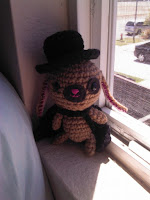
Thurston: Magic Bunny
Named after a great
magician. Made for a
great magician.

The first toy I ever made on the
left compared to my current work.


If you've never crocheted before, but are interested in doing it now, this is a great book to start with. The beginning "guidelines" are an easy-to-follow, crash course tutorial on crochet. Also,  as I mentioned previously, the patterns are simple to follow. (That's one of the beauties of crafting and especially crochet: if you can read the pattern, it's awfully tough to mess it up.)

Amigurumi World features about 22 patterns of different animals. You'll notice, if you make multiple toys out of this book, that a lot of these patterns are a repeat of one basic toy with different details. The type and color of your yarn, and the details (like nose, eyes, mouth, and accessories) are what will make your creations unique to you and different from each other. They'll still be based on the same basic pattern, but no one else needs to know.

Even if you're not a novice to crochet or amigurumi, I would still recommend this book. It has cute ideas, is good for inspiration, and the basic patterns are versatile. Your creations will only ever be as amazing as you make them, but the tools to help you are there. ... Except for the crochet hooks and yarn. You'll have to buy that stuff separate. Oh, and speaking of crochet hooks and yarn... If you want a cheat sheet to what you'll use most often if you're following the directions to Amigurumi World, you'll want to have the following handy:

  1. Crochet hooks sizes F & G (that's American for 3.75mm and 4.25mm) These are the most commonly used hooks in this book.
  2. Medium Worsted Yarn. (That's size 4, on the label of yarn. It's the most common size, so it'll be the easiest to find in a wide variety of colors.)
  3. Felt, Buttons, Safety-backed eyes. For faces. ... If you want to give your toy a face, that is.
And that's pretty much it! So again, if the rest of the review didn't already impress this upon you: If you don't own this book, you're missing out. I love it, and I highly recommend it. Mine is in pieces from how much I've used it over the years. It is definitely worth the money!
Amigurumi World: Seriously Cute Crochet on Amazon.com

Kristi from TechGal comics by Timothy James
Available Here
Tune in next time when I tell you how I really feel about something else! It may or may not be about Creepy Cute Crochet. See you then!