Showing posts with label fantasy. Show all posts

Friday, January 6, 2017

Ghosts from Our Past A.K.A The Ghostbusters Movie Tie-In


There's just one question you gotta ask yourself before you read this book... Are you a HUGE Ghostbusters nerd? Seriously. Do you live, eat, and breathe for the new Ghostbusters movie? Because I get a sneaking suspicion that having merely "liked" the new movie will not be enough to get you through this.
As you may have already surmised, I am not a HUGE Ghostbusters nerd. I am a fan of the original movies, but was unable to see the new one. But then I saw that Blogging for Books had this available, and since I couldn't convince my significant other to go see the movie with me, I figured I would read this instead. Blogging for Books graciously acquiesced to sending me a free copy (in exchange for a fair and honest review, of course), and here we are now— about 3 or 4 months after I received it.

Okay, here's the thing: This is not a bad book. I've certainly read much worse. But I've also read much better. I guess that, once again, this falls under the category of books that just weren't meant for me. Since I did not see the movie, I'm not sure if this book actually shows up in it. However, the basic premise of Ghosts from Our Past is that ghostbusters Erin Gilbert and Abby Yates (the characters in the movie) wrote it together while they were undergraduates in college. The book is split into three basic parts: Ghostbuster backstories (or how Erin and Abby got into spooks), their research, and their methods. I made it as far as the methods section before I gave up. Honestly, I think the biggest issue I had with this book was its length. It isn't nearly as bloated as Les Miserables, but I would've been happier with fewer pages in their research and methods section. But I'll explain that further soon.

Let's move on to the fun stuff in Ghosts of Our Past. A lot of the humor in this book works because it's meta. This is written as though Erin Gilbert and Abby Yates are real people who legitimately believe in and hunt ghosts. They are "real," and their research is "real," and they passionately try to explain it to you. As a reader, I wasn't just reading a fictional book based on a movie. I was handling an artifact from another dimension, and my guides to that dimension were a couple of passionate, kooky, spook hunters who love the X-files and have no clue how to write a scientific report. The very first page made me laugh with the included praise from diverse sources like New York City's mayor ("An imaginative work of fiction, written by two women I have most definitely never met. Are you recording this? Turn that off."), and an Amazon review that simply read, "5 stars. Arrived on time. Good condition." If you read this book, don't skip the captions. They are funny.

And now that I've had a little bit of time to explain to you what's good about the book, let me go back to what isn't: the pacing. I know earlier I said it was the length, but this isn't that long of a book. The pacing is what's really off. It starts out pretty funny, keeps that momentum through the back stories, and starts losing steam around the middle. That's why it took me so long to get to the third portion. It really slowed down toward the middle, and I just never felt it pick up that pace again toward the end. Then I gave up. Chances are that I will eventually finish reading this book. My bookmark is still where I left it. Overall, I'd say this is good bathroom reading material, but that's about as good as it will ever get.

Monday, October 3, 2016

Halloween Freebies!

I'm currently working at a Halloween City. I could've started blogging about Halloween in August.
Hey guys! I just wanted to point you towards some books I found free on Amazon. No particular reason other than "people like free stuff, right?" Some of these books I have read before, and others I'm going to try out this month. Care to read with me?

I mentioned How to be Dead to you last year on Halloween, then I went on to read it. You know what? It was hilarious, and I loved it. The first book is still free on Amazon, and the second book— Paper Cuts— is well worth the $2.99. They're short, horror comedies and you really can't go wrong with them. I'll probably review these two sooner rather than later. The only thing that bugs me is that there is a third book in the works, and it isn't finished yet. So I'm bummed about that, but these two are still so worth your time.
Did you know that a metric butt-ton of classics are available for free on Amazon, if you're getting them on Kindle? I mention it because I forget all the time. Since Kindle is my digital platform of choice, I started loading it up with all kinds of stuff for the season, including: Frankenstein, Dracula, The Strange Case of Dr. Jekyll and Mr. Hyde, The Picture of Dorian Gray, and War of the Worlds. If you've read them before: good for you! I read Frankenstein in high school, and Dracula during college. Though they both started slow, they got much better. I was even able to get over having to read in the dreaded first person perspective during Dracula. Before the month is done, I hope to get around to The Picture of Dorian Gray, and Dr. Jekyll and Mr. Hyde. I'm one of those people that likes getting around to the classics. It gives me more meme material.

I hope this will keep you all satisfied for a couple of days at least. Enjoy! And if you have a minute, leave me a comment with what your reading list looks like for this month. I like getting recommendations too, you know!

Saturday, October 1, 2016

Art of Coloring Disney Villains


How do you like your Disney villains? Do you like them devious? Cunning? How about hipster-y, self-centered, and covered in patterns? Then have I got a treat for you!

I see you found a Disney coloring book more suited to your tastes.
Yes, though I only had a chance to flip through it. Art of Coloring Disney Villains is a little thank-you gift I bought for one of my friends. It's weird at times, but thankfully still entertaining. Unlike in the Disney Princess coloring book, the characters in Disney Villains are allowed to express a wide range of emotions while reenacting scenes from their movies or otherwise posing with new, "updated" material. Probably one of the funniest examples of this are the several images of Gaston from Beauty & the Beast as he takes an endless stream of selfies on a smart phone. Yeah. Wrap your head around that one. You'll see it makes complete sense— if he had a smart phone. One of the repeating "wallpaper" images is multiple villain faces wearing hipster glasses. Weird? Yes. Entertaining? YES.

The book is split into several different sections: animal kingdom, strictly human, and witches/creatures. As an unexpected bonus, most of the villains in the book also have a small, card-size portrait with information regarding: their movie, when it was released, and who voiced them. As with Art of Coloring Disney Princesses, this book is also that strange kind of hard cover (where it's a soft cover book with cardboard on the front and back). I still don't get it, but since the images were so much more fun for the villains, I really didn't mind so much. My favorite thing about this book, though, is that each of the villains has at least one image that include the movie's heroes as well. In each of these, the villain looks (appropriately) menacing— or looms over— the heroes/heroines; especially Izma from Emperor's New Groove. So what if they drew her with a piece of spinach stuck in her teeth? She's still a badass!

If you're interested in purely classic villains doing only what they do in their movies, I recommend you move along now. As previously mentioned, they took some liberties with these characters. However, since they are still "in character" for the most part, I forgave the artists and would be happy to have this book for my very own. I recommend you get one for yourself as well!

Saturday, September 24, 2016

Inkheart: A Reminder Not to Judge Books by their Cover


As you may recall from another post, I unintentionally read three different versions of Taken recently. Inkheart by Cornelia Funke was the second one I read, but the first "reverse Taken" that I'd ever encountered.

Oh, so the dad gets kidnapped and sold into sexual slavery in this too? I thought this was a young adult book!
I think this is actually a children's book, and yes the dad gets kidnapped in the beginning. Luckily, neither he or his daughter are sexually molested. The father's kidnapping at the beginning of the book and the daughter's desire to run off and find him are actually the furthest Inkheart makes it into the Taken plotline. In reality, the plot is equal parts "be careful what you wish for," "don't judge a book by its cover," and missed opportunities. I felt the "don't judge a book by its cover" part most keenly since based on the cover and description on the back, I was expecting a more exciting, magical adventure with our little girl protagonist. Based on the description, our 12-year-old heroine— Meggie— is thrust into a book-like adventure where only she "can rewrite the story" and ultimately give it a happy ending. Based on the cover, I expected that adventure to include at least one minotaur, one unicorn, and a troop of flying monkeys. There were no minotaurs, unicorns, or flying monkeys. There was barely even any adventure. Instead, we had a series of kidnappings: first the dad, then the girl, then they escape, then Meggie gets kidnapped again, etc.

That sounds frustrating.
It really was! The sad part is that Cornelia Funke set up some legitimately good hooks at the beginning of the story, which were then resolved in a lackluster sort of way. For the first 300 or so pages, I was convinced that the story would get better! "Wait until I get to the part where they reveal this, and that, and the other thing!"

The way things start out is that 12-year-old bibliophile Meggie wakes up in the middle of the night to see that there is a strange man standing outside of her home. In a fit of panic, she rushes to inform her equally bibliophilic father so that he might send the stranger away. Her father is actually acquainted with the man: Dustfinger the fire-eater, who has searched for them in order to warn them that someone is on their trail. Meggie's father, Mo, possesses a certain book that our story's villain desires, and they must keep it from him at all costs... Thus, our beginning hooks: What could Capricorn, our villain, want from our book-binding papa (Mo)? What's so special about this book he wants? Why is Dustfinger warning them? Is he ally, or foe?

Who the hell names their kid "Capricorn," or "Dustfinger?"
Authors, of course. You see, Dustfinger and Capricorn do not belong in Meggie's world. They are actually characters from a book titled Inkheart, written by some guy in Italy (inside of Cornelia Funke's Inkheart).

It's just a book... No harm ever came from reading a book.
Meggie's father possesses a strange power: whenever he reads a book out loud, something ends up popping out of the book. Sometimes, it may be a bird, or a gold coin. However, for everything that comes out of the book, something else must go into it (presumably to maintain some sort of balance). In the instance of Inkheart, various characters— including Dustfinger, Capricorn, and several of Capricorn's henchmen— make it into Meggie's world, and her mother disappeared into the world of the book. Now, nine years after their appearance in Meggie's world, Capricorn has gathered and destroyed all copies of the story he came from. He needs only the one Mo owns to bring forward more of his evil cronies...

You wrote a book in a book that was better than the book you wrote...
Oooh... Book-ception!
It really did take approximately half of the book to get that all set up, and by then there had already been a kidnapping or two in progress. After that, it all went downhill. Unfortunately, the characters just weren't compelling. For example, as a reader I was told that Dustfinger was really an affable character in his book! However, in the actual book that I was reading, he was pathetic. He was desperately unhappy to be out of his story and wanted nothing more than to return home. Dustfinger gives Mo and Meggie up to Capricorn thinking that somehow— despite all of Mo's previous attempts to read him back— being under Capricorn's scrutiny will force Mo to control his power and send Dustfinger home! Meanwhile, Capricorn was repeatedly described as being a terrifying villain in his own book, with dead eyes devoid of pity. To encounter him in the book I read was to read about a man who wanted gold, and weapons to frighten people with. Color me unimpressed with his goals to be the douchiest douche-nozzle that ever douched. Capricorn is the sort of character one would call the police about, because they can handle him. He didn't have any particularly special powers, so I don't understand why the cops in the book were such pushovers that they didn't just go out and do their jobs.

Their families were being threatened?
Boo-fucking-hoo. You know what would help? Arresting the bad guys! The worst part, though, is that Inkheart spent a lot of time telling me how great Inkheart was. If the story these awful characters came from was so great, how come I'm not reading that instead?! Overall, the writing wasn't bad, though things did get tedious toward the end. I could have done without the repeated kidnappings, for example. Mo and Meggie's curse/ability to read characters out of their stories was an intriguing concept that got me to start the book, but only sheer determination on my part could make me finish it. Funke missed so many opportunities to make this a better story. I think she got lost in the cleverness of having a great book tucked away in a mediocre one.

Saturday, September 10, 2016

Art of Coloring Disney Princess: 100 Images to Lull You into a Catatonic State


This book was not made for me. When I see the title Art of Coloring Disney Princesses, certain expectations and standards come to mind. I expect a certain amount of froufrou nonsense and hoity-toityness featuring a pack of damsels in distress. Then I remind myself that "Disney Princess" refers to more than the classic damsels like Snow White, Sleeping Beauty, and Cinderella. My hopes rise, knowing that bad-asses like Mulan and Merida might be present. Let's not forget that Jasmine, Tiana, Rapunzel, and Belle are also intelligent, quirky, and brave. So I bought this Disney Princess coloring book with the expectation of seeing a variety of "princesses" doing and being more than decorative damsels in distress. Further, I expected the artwork would meet the high Disney Standards: interesting, dynamic, and beautiful. What I got amounts to little more than a Barbie-like coloring book with some characters standing or sitting around, looking pretty, with vacuous smiles plastered on their faces.

How do you know they're vacuous?
Because their eyes are glazed and unfocused, and they're staring at nothing in particular! The whole book is generic, discount, knock-off Disney at best! I find it insulting— to me as much as to these princesses— that they should take some genuinely interesting characters and have them only stand or sit, and smile at the camera. These ladies have better things to do! Tiana has work to do. Mulan has villains to outwit! For fucks' sake, Belle has a giant library to read, and Aurora could be taking a nap, and these artists interrupt their busy ass schedule to have them stand against a backdrop and smile?! Or they got a Disney Princess stunt double to sit/stand against a backdrop with infrequent wig and wardrobe changes.

You got a problem with looking pretty and having a rich husband?
Not at all! If you're pretty, have a rich husband, and that makes you happy? Good on you! I simply find it dull. My high school yearbooks were more interesting than that! Which leads me to my biggest problem with this book: It is mundane, uninspired, and mediocre. You're more likely to be lulled into a catatonic state while coloring these pages than be creatively inspired. But prepare yourself. There's a kicker. ... Are you prepared?

You're the Diet Coke of Disney. Just one calorie: not Disney enough.
I think so...
Of the approximately 120 pages to color, 98 are dedicated to generic, repeating wallpapers. I know. I counted. For the purposes of this math, I want you to understand that if the image was a mandala with a princess silhouette or a repeating pattern, I counted it as "wallpaper." Therefore, not really a princess. Just patterns. There were only 23 images of princesses (with vapid smile facial details), and even some of those pages were more patterns than princess.

Overall, I found this book terribly disappointing and misleading. It is monotonous at best, and I don't recommend it at all. In addition to all the problems with content, the book itself is odd in that it is a hardcover coloring book—

That's kinda cool!
—but the covers are actually just cardboard pieces stuck on the outside of a soft-cover book. It makes little sense, and it looks weird. It doesn't really bother me. I'm just annoyed at the book in general. But that does bring me back to my first point: This book wasn't made for me. I gave it to my friend, and he loved it. Know your audience, I guess. I bet my audience loves narwhals.

Saturday, August 27, 2016

A is for Adventure: Part Coloring Book, Monster Manual, Campaign Guide. ALL Fun


The other day, I went on a little shopping spree for my friends. I am not allowing myself to spend much on myself lately, but I wanted to get a few little thank you gifts for my D&D group so... I bought coloring books. Of the three that I bought, my absolute favorite is A is for Adventure, by Scott Aleric. I want this book for myself and I want it now.

So the artwork is good?
Yes, but that's not all. This book is fantastic! I appreciate Aleric's style and the attention to detail. All the monsters are displayed in dynamic poses— typically in the process of mauling some foolish adventurer. The illustrations are worked in ink with full backgrounds and— Okay, you may find this a little bit strange, but...

I've read your other reviews. How could this be any stranger?
—what really does it for me is the hatch and cross-hatch shading. I love the texture it creates on the page. It's something that I just don't see all that much anymore, especially as more artists do digital art. And I haven't even told you about my absolute favorite part!

There's more?!
Yes! Included with each letter/monster is a mini campaign scenario featuring the monster, a small map, and even some plot twists to kick things up a notch. What I particularly love about these adventures is that they act almost as adventure-Legos: you could play with them on their own, put them together, or drop it in to your bigger campaign set. Tweak the scenarios to taste! Overall, I highly recommend this book! You'll like it too if you're into: 
  1. Coloring! The pages are thin, but single-sided. No worries about markers bleeding through to the next page.
  2. Role-playing! Mini campaigns need little customization if you're a lazy dungeon master or you just want to sample playing with friends.
  3. Monster art! Most of the illustrations look like the monsters are winning. That's typically a plus in my book!
Have fun!

Thursday, August 4, 2016

Dragons of Spring Dawning: The Forgettable One


Have you ever read a book and come out of it feeling as though you've fought with a friend?

Uh oh... What happened?
Unfortunately, not much. That's the problem. I think it's likely that Margaret Weiss and Tracy Hickman heard what was being said about their previous books and took actions to "remedy the problems," resulting in a bland and anticlimactic third installment. This series has been around since the 80s, but many of the things that I mentioned in my previous reviews have been said before. And I noticed a progression of changes from the first book to the second, and from the second to this one.

In Dragons of Autumn Twilight, I felt as though I were reading the annotations of an actual Dungeons and Dragons game. It was silly, but fun overall. Every time the characters camped for an evening, we knew about it, and that's actually how I imagined we were keeping track of their sessions. Granted, that really slowed things down, but not so much that I didn't enjoy the book. So I picked up Dragons of Winter Night, and again thought, "Silly, but fun!" My favorite parts were the most ridiculous, involving Fizban the Wizard's shenanigans and gnomes that had to cram whole paragraphs in the breath most people use for a single sentence. I enjoyed telling everyone who would listen about the dragon balls and how they worked more like defective dragon siren/whistles. Weiss and Hickman fixed some of the major problems slowing the story down, reduced the amount of Deus ex Machinas used, and kept the silly fun stuff. The second book reached an unpolished sweet spot I believed would terminate in a great third book.

Because third time's the charm, right?
Not quite... Not this time. I suppose the writers intended their story to be more serious, or dramatic. Again, in Dragons of Winter Night, I thought they'd achieved a balance between silly and serious. They even went so far as to kill a main party member and not bring him back! I was proud of them for that! But then, in Dragons of Spring Dawning they took it a step further— they took the fun out of it. All the silly humor is gone— no gnomes, barely any Fizban, and no moments or plotlines so ridiculous I laughed out loud. The writing was never that strong or engaging, and the characters were uninspired. Yet, nothing about the series was ever so bad as to make it stand out, either. It wasn't terrible or great. With all the silly removed, it's vanilla. Actually, at times it was downright irritating. For the better part of the series, the main party leader — Tanis Half-Elven— acted like a moody teenager. Instead of a competent, mature leader able to make split-second decisions that might save the world (or at least his companions), Tanis spends the majority of the book mooning over the villain. Yes, you read that correctly. Tanis, who harbors a major boner for a mercenary named Kitiara, discovers that Kit is a dragon highlord in service to the Queen of Darkness. That makes her the villain of the story.

Does this also make her off-limits?
Hell no! He taps that as soon as he gets a chance! Do I begrudge him this momentary sexual weakness? Maybe a little, but I could totally get over that. My issue with this is that afterwards, when he "escapes" Kitiara's sex-lure and returns to his friends, all he can feel is extreme guilt about his little adventure.

Naturally, he tells his friends where he's been and what he's learned! Right?
HAHAHA—! Wait, you're serious? Of course not! He can't just tell his companions— two of which are Kitiara's younger brothers, by the way— that he's been carousing/boning with the enemy! Never mind the fact that he learned valuable intel that could have helped them in their journey, or that keeping the experience to himself gnawed at his conscience until he was practically useless as a leader. Can you imagine how that conversation would've gone?

Tanis: Hey guys, I learned about this thing the Queen of Darkness really wants! And I know where it is, so we have to get it away from her!
brothers: Really? Tanis, where did you get this information?!
Tanis: From boning your sister. Let's go!
brothers: ... We're going to have a serious conversation about this later, but let's take care of the thing that's likelier to save the world first.


For crying out loud, how hard is it?!
Have you noticed that I have zero patience for whiners and liars? Seriously, how difficult is it to just tell the damn truth?! And the lie and guilt just drag on for so long. God forbid they should excise all the brooding and replace it with something more interesting, or hasten the end of the story.

Speaking of story...?
Yes, moving on! The companions' main quest throughout the book is to find someone known as the "Green Gemstone Man," so called because he has a green gemstone embedded in his chest. I have a different name for this character: Dragonlance Jesus. But not just any dragonlance Jesus! This is Tanis Half-Elven's own, personal dragonlance Jesus, who died and was resurrected to free Tanis from the burden of his lies and guilt. Sound like bullshit? That's because it is. Dragonlance Jesus has spent hundreds of years running from the Queen of Darkness because he is the key she needs in order to enter the world and completely take it over. For hundreds of years and on hundreds of occasions, dragonlance Jesus has died only to come back to life in the same body.

He's a lich! Burn the lich!
Not quite! He's actually blood-cursed after accidentally killing his sister. I believe the gemstone embedded in his chest binds him to the curse, and the only way to break it is to break the gem against the column where his sister died. Then, he is free to stay dead. But until then: Don't worry, Tanis! Go right on ahead and stab green gemstone man through the gut with your sword! Feel better? Oh, good. Because that was totally like stabbing the pimple of your own guilt and squeezing until the pus is gone. Now the throbbing ache of your weakness and lies can subside. You have been redeemed, thanks to an unwilling dragonlance Jesus. How fortuitous!

Oh, come on!
You're right. That's horse shit!
Of course it's horse shit! It was the weirdest, most nonsensical, unenjoyable bit of ridiculousness in the entire book. At that point, I could only be grateful that I borrowed the thing from the library and didn't actually pay money to read it. But I read on, hoping that the final fight with the Queen of Darkness, her dragons, and Kitiara would be epic enough to make up for the sophomoric brooding and whining I'd been subjected to thus far. Our adventurers were down one more character, having lost their useless but lovable grandfather dwarf to a heart attack. That left six fighters against an evil goddess and her armies. What will happen next?! They get caught, obviously. They walked straight into the enemy encampment in an effort to save their elf-maiden general, and they get caught. Sure, they donned disguises first, pretending to be officers of the enemy army with prisoners. But they weren't very good disguises, and all of them but Tanis get tossed into jail and eventually have to break free.

How did they escape?
Honestly? I don't entirely remember; I did mention this was the forgettable one of the series. Not exactly the best way to end things. I believe they escaped using a combination of Deus Ex Machina, misdirection, and tons of dumb luck. They had the green gemstone man with them in prison, and when they break out, so does he. He immediately runs for the place his dead sister is calling him from, finds the column at which he killed her, and flings himself upon it! Thus, dragonlance Jesus finally dies, and the Queen of Darkness has the door of the world slammed in her face. She never even made it into the world, mind you, so the companions never actually had to fight a goddess; only her influence. After that, it was all chaos and shenanigans. I think at that point, the writers stopped caring, and so did I. They built up this antagonist for the entire series, and dumb luck defeats her. We didn't even get an epilogue of some sort about what the characters did afterward.

Overall, I was disappointed with this book. It was less fun than the previous two, more brooding, irritating, and anticlimactic. Weiss and Hickman did leave a few scattered hooks for later books regarding Raistlin and his powers, and I'm curious to find out more about the only truly interesting character in the series. However, after this last installment, I can't say that I'm in a rush to read the other books. I wouldn't recommend this book, unless you really want to find out how the series ends. Or, if you're not a book completionist, let me just tell you that they win. Make up whatever scenario you like for how they do it, and it'll probably be more satisfying than this was.

Thursday, July 28, 2016

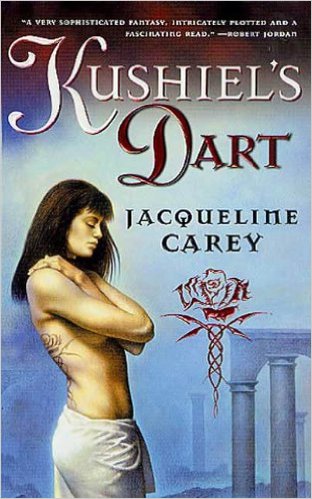
Kushiel's Chosen a.k.a The One Where True Love is an Ass


So, did you guys run out and read or listen to Kushiel's Dart after my review? I mean, the story was only amazing, so I guess I understand if you didn't prioritize that this week...

Sarcasm? This early in the post?
It's never too early for sarcasm. Besides, I only ask because I somehow managed to not have a ton of spoilers for that book in its review. However, your spoiler-free reviews end now. I'll try to avoid major spoilers for Kushiel's Chosen— the second book in the series— but prepare for some new info from the previous book to crop up. It has to, because there is no way I could review this otherwise! I will do my best to keep it condensed. Oh, and one more thing: since I've been listening to these as audiobooks, I'm not really sure how to spell the characters' names. It'll probably be more weird for me than you, but I just wanted you to know what's going on.

Consider us warned. Carry on!
Very well, then! In Kushiel's Dart, we were introduced to the world of Terre d'Ange. Imagine that angels landed in France and bred with the populace. Due to their celestial ancestry, the d'Angelines (as they call themselves) are considered to be the most beautiful people ever, awash in talents, in a country overfull with richness. This is great for them, of course, but it does make them somewhat conceited. It also makes their country a target for threats, when others want all their beauty, science, and fancy ways. Their religion and culture are centered on the precepts of their main god, Elua, who bid them simply to love as they will. And they do. The d'Angelines have raised love-making to an art form, worthy of being taught, practiced, and used as a means of worship as well as pleasure. Much of what they do, they do for love.

What the hell does "loving as they will" mean?
It means, "you do you." Would you like a plethora of lovers who all know about each other? That's cool. You do you. Want to add some group sex to that? Go for it. Your preference is for monogamy? Or celibacy? To each their own. How about group bondage sex? No problem! Just remember the safe word. Above all: keep it consensual, and love as thou wilt. It makes for some interesting pairings.

I mentioned in the review for Kushiel's Dart that there was political intrigue, fights, monsters, and True Love. When Phaedré nó Delauney is sold into slavery in the previous book, she goes with her bodyguard: a young, celibate, warrior priest named Joslin Verai. Potentially due to the adrenaline-fueled nature of their time together, they fell in love as they escaped captivity. It's all very romantic, but let's stop for a moment and consider the spiritual and mental ramifications for Joslin: after 12 years of rigid, prudish education and training, he breaks every vow he made in order to protect and serve his ward (who just so happens to be the courtesan spy he now loves). There are metric butt-tons of guilt for him to work through, but he manages. He's surly about it sometimes, but he manages. Having given you the barest amount of background I can get away with, we can now move on!

Kushiel's Chosen picks up with the bait left at the end of the previous book. Phaedré is convinced there is a new plot against the queen of Terre d'Ange when she receives a package from Melisande Shahrizai— the woman who sold Phaedré and Joslin into slavery and escaped her death sentence for treason. In an effort to find the truth and locate this dangerous enemy of the state, Phaedré returns to the service of Naamah.

She what now?
Try to keep up. Naamah is the d'Angeline goddess of love. By returning to Naamah's service, Phaedré is practicing her trade as a courtesan. Her ulterior motive, of course, is to glean information from her patrons that could help her locate Melisande and stop her nefarious plots. This is where True Love starts to be an ass. Despite Phaedré's sound reasoning, Joslin disapproves of her plan vehemently. Her return to Naamah's service strains their relationship almost to the breaking point, as neither seems willing to come to a compromise. Actually, that isn't true... Phaedré is willing to compromise with Joslin on many things, and Joslin will compromise on nothing. Though he does not outright leave her, he is often absent and thereby negligent in his duty/vow to protect her.

But you can't expect someone who only believes in monogamy to be okay with having a prostitute for a girlfriend and stick around!
Yes you can. If Monogamy Bob falls in love with Polyamory Sally knowing full well that she's into multiple people, I expect him to suck it up and deal with it. Does he have to like it? No, of course not. He just has to find a way to deal with it. If it doesn't work out, leave. Hence, I totally side with Phaedré in this book. She was always honest with Joslin about who and what she is. She is also well aware of his vows, and how it would hurt him if she tried to solve this mystery Melisande baited her with. She laid everything out in front of him and told him why she had to do it. If he doesn't agree, so be it. But for fuck's sake, dude, pick a bloody side. Work something out, make an agreement of how long this can go on, and then revisit the agreement if you must. Or leave. Instead, Joslin is contantly sulking, and I spent a great deal of time wishing a fictional character were physically in front of me so I could punch him for being such a stubborn mule.

Sounds like you're kinda mad at this dude.
Yes! Because Joslin's vow to protect Phaedré is the reason he won't leave her, but then he is often missing when she needs protection! To make matters worse, he then blames her for going off without an escort. I want so badly to beat the crap out of him! For about two-thirds of the book, anyway. That's when shit hits the fan, Phaedré gets tossed in a foreign prison, and Joslin makes the most daring rescue attempt I've ever read. It might've worked, too, if she hadn't fallen off that cliff!

No way?!
Way! It does take approximately two-thirds of the book to set up, but when that domino effect gets going— it is an insanely satisfying experience. Phaedré hunts for traitors at court, and their trail eventually leads her and her companions to leave Terre d'Ange for the city state of La Serenissima (which is essentially Venice). There she finds her traitors in the last place she ever would have thought to look. That's when she gets tossed in jail and Joslin, finally realizing that he cannot live without her, goes to her rescue— only to have her fall off the side of a cliff. Again, I'm kinda mad at Joslin, but he so makes up for all the crap he pulled from that moment forward. From there on, you just get so excited for them to be reunited! Because she doesn't die, of course.

What?
She doesn't die. I'm just telling you that because you looked scared.

I wasn't scared. I was just concerned.
Sure you were. Well, she doesn't die. She almost dies, having fallen off the side of a cliff and into the sea. Luckily, though, she gets picked up by pirates!

You lie!
No, I'm not making this shit up, I swear! Look, aren't you convinced yet that you just need to go read this book?! I'm afraid that if I were to go into every little detail that makes this such a great book, worthy of being read repeatedly, I would end up writing a series of essays. I haven't even told you guys about her best friend and how she's trying to break the curse he's under, or her men at arms, or the queen she loves enough to get herself into such a mess!

Yes, Kushiel's Chosen does take a little longer than the previous one to get going, but once it does the experience of it is phenomenal. And yes, I know I spent most of this review describing the story in terms of how the main guy is being such a jerk, but only because that's one of the main ways I remember it. I remember it because I love the characters, and I want them to work together and be happy, but then of course we wouldn't have a story. So instead, I'm listening to all of the shenanigans, the intrigue, the web of lies and sex thinking, "I love you guys. I can't wait for you to be happy again."

I'm just going to warn you right now to clear a day or two on your calendar, because it'll be tough to put this down once you get started. It made me laugh, and legitimately wrenched a tear or two from the depths of my little black heart. If you haven't read the previous one, that's actually okay. One of the things that slows the story down some is how it repeatedly touches on some of the things that happened in the previous book. So if you're okay with jumping around in the series and you want to start in the middle, that's okay! You won't be completely lost. And if you've already read the first book, then you're totally set to start on this one. So go on! Get reading! You can thank me later for recommending it.

Thursday, July 7, 2016

Commute Saver: Kushiel's Dart


If you have kept up with my blog, you may remember that I have a long commute that I absolutely hate. I listen to audio-books to make it bearable, but for a month or more I kept forgetting to swap out what I had available. Luckily for all the drivers I share the road with, I finally swapped out Stephen King's The Shining for something less likely to fuel a deadly, maddening rage: Kushiel's Dart, by Jacqueline Carey.

First things first: this book is amazing. The whole series is phenomenal, actually. This isn't the first time I've listened to it, and it's a wonderful experience every time. I mean that to the point where I might sit in my car for a few minutes longer after I get home just for a bit more story. I've been taking long walks the past few days— despite the high temperatures— just to have an excuse to immerse myself in the world of Terre d'Ange longer. This is due in part to the writing, of course. But before I get to the story, I want to point out that the voice actress for this series— Anne Flosnik— has a beautiful and captivating voice. I can, and do, listen to her for hours. It's a little like listening to a long-time friend tell me about her adventures as a super sexy spy.

Begging your pardon?
Well, that's the gist of the story. Phaedre nó Delauney is a courtesan, trained as much to observe and analyze behavior as in the arts of pleasure. When Phaedre's bond-master is slain and she— along with her bodyguard companion— are sold into slavery in a hostile country, they must pool their resources (wits and talents) to escape captivity, return home, stop a war, and save their monarch from certain death. On the off-chance that you are not yet convinced you must read this book, I add this: there are sex scenes and they are beautifully balanced. There are not too many of them, but not too few, with enough flowery writing not to make it seem vulgar, yet let you know exactly what is happening. They are hot and— like Goldilocks' bed— just right.

Actually, I daresay it's unfair to refer to the sex scenes as "just right," when the entire story hits a phenomenal sweet spot. My favorite part about this package is probably the complexity of the characters. Phaedre's beautiful face and often submissive demeanor hide a cunning mind capable of matching wits with Moriarty-esque antagonists. She is often underestimated, and she uses that to her advantage. But she is also rebellious and proud, which lands her in deep waters with deadly undertows of trouble. Even the side characters have feelings, traits, and multiple drives. I often see the intellect and talents of side characters compromised to make the protagonist appear smarter and more capable. Personally, I consider that to be lazy writing, and am happy to report that you will not find that in this book. But you will find fencing, fighting, torture, revenge, giants, monsters, chases, escapes, True Love, and miracles...

To sum up, Kushiel's Dart is an amazing beginning to an epic series. It makes me squeal with unabashed delight, and I recommend it to anyone who will listen. Now you know you need to read it. Will you read it or listen to it on audio? You won't be sorry, either way.

Saturday, June 18, 2016

Shenanigans Continued: Dragons of Winter Night

Would you just look at these goofballs? Two of them aren't even facing the right
direction to fight a dragon!
My research into the D&D world and lore continues with the second volume of the Dragonlance Chronicles! Last time, our reticent adventurers faced one dragon, summoned two and a half Deus ex Machinas, and seriously considered putting on their big boy/girl pants before getting to the business of saving the world.


Two and... one half? You hadn't mentioned this before!
Don't worry— the other half shows up in Dragons of Winter Night. I'm not certain what possessed authors Weiss and Hickman to go and kill three separate characters in their previous book, then immediately resurrect two of them. However, I can tell you that it was damn obvious the third one was either not dead or wouldn't stay dead long. And I was right— but this time I was pleased at the "resurrection." Fizban the wizard is a weird and sometimes bumbling character, but he's my favorite and I was happy to see him again— despite receiving ZERO explanation as to how or why he shows up again. One of the other characters literally just stumbles across him midway through the book— he was taking a nap in an out of the way corner of a dragon's lair— and they have this "moment."

Like a sweet and romantic moment?
Nope! It ran a little something like this:
Tas: F-Fizban!
Fizban: WHERE?! ...wait, isn't he dead?
Tas: That's what I thought! I saw you fall in a flurry of chicken feathers!
Fizban: Chicken feathers? How dreadful!
Tas: I wanted to go back and find your body, but was assured there was no point— but your memorial was beautiful!
Fizban: I didn't realize I'd kicked the bucket... Was there a twenty-one gun salute?
Tas: What's a gun?

It went on like that for a few pages. Yes, it made that much sense. What this series does unexpectedly well is ridiculously random little details of the "what the fuck?" variety. Those are the best parts of the story, and they are not the main ones. I believe these are the unplanned, role play portions of the book. A group of weirdos got together, had fun, and this series is the result.

So it still feels like a series of dice rolls gone right?
That feeling is drastically reduced in Dragons of Winter Night. The story flows considerably smoother, even though our heroes have been split up into two groups. Each group seeks the ultimate weapon to combat the oncoming dragon threat. At first, it seems that they all must get together and discover the truth behind the mythical dragonlances— the only weapon thought to be strong enough to penetrate a dragon's hide. But then we find out that those aren't the only or most important weapon.

What IS then?
Dragon balls. Our heroes spend nearly the entirety of the story searching for orbs made by the most powerful of wizards in previous ages. Any one of these dragon balls—so called because they've been imbued with the essence of dragons— will summon all dragonkin in the near vicinity because reasons. We are not privy to what these reasons are. The dragons cannot refuse the siren call of the orbs. This seems a terrible idea, given that the balls don't actually control the dragons; just call them over. Why not just get a dragon whistle? Or some dragon pheromones? No, instead they go through all the trouble to find these rare dragon balls that they can't even use without losing their minds.

Does that count as spoilers?
Have you learned nothing from my reviews? Nothing is sacred! Besides, I'm not revealing more than the chapter titles do. You can get a fair idea of what will happen in the story simply from reading the chapter titles. Each one gives you a "preview" of what happens therein. For example, in one chapter, an elf king named Lorac tries to use a dragon ball to save his land. "What will happen next?!" I wondered to myself. I didn't wonder long, for the first thing I read on the next page was, "Visions shared. The Death of Lorac." Weiss and Hickman: Scheherazade they are not.

Are you sure you're enjoying these books?
I am, I promise! They're only a little frustrating sometimes— when they slow down for their little romances or give away what's going to happen in the chapter title. The random banter between characters is entertaining, and the storytelling has smoothed. Overall, the experience is improved. So I can recommend Dragons of Winter Night more than the previous book! Go check it out!

Thursday, June 2, 2016

Nerdgasms: Dragons of Autumn Twilight

Five hours of mostly snap decision-making
ultimately yielded this weirdo. Artwork by
myself and Timothy James.
Last week I was drafted into a Dungeons and Dragons game for the first time in my life. Having never role-played in person, I wasn't sure what to expect or how things would progress. However, as I created my character— which was an arduous, five hour, brain-birthing process that resulted in a "tiefling bard" for anyone who's curious— I realized that to play in a fantasy world, it might help to immerse myself in a fantasy world first. Dragons of Autumn Twilight, by Margaret Weis and Tracy Hickman, is the world I chose.

Seeking inspiration?
Actually, I vaguely recalled from the last time I read this book that it was set in the Dungeons and Dragons universe. So this technically counts as research, or reading an entertaining history book. Who said research can't be entertaining, after all? The good news is that you don't need to know anything about— or be interested in— D&D to enjoy this book! Knowing a thing or two about tabletop role-playing games might explain a couple of minor points in the story, though. I will tell you about those in a minute!

The plot seems solid: a band of "unwilling" heroes find themselves thrust into a dangerous quest to save the world. I use the word "unwilling" loosely. Our heroes may play coy, but beneath their protestations, the whole group is getting off on putting their lives on the line. After five years of solo-questing, five friends return to their hometown to share their findings from around the world. Rumors of impending war abound, though no one wants to believe it. Their reunion is interrupted when two strangers— a barbarian couple— enter the bar. When the barbarian woman, Goldmoon, sings a song about how they arrived to town, one of the locals takes offense and insists that she and her companion be arrested. Then, Mayor Douche-nozzle—

Please tell me that's really his name.
Unfortunately not, but this does accurately describe that background character. As I was saying: Mayor Douche-nozzle, having already imbibed more alcohol than is generally recommended, trips and falls in the fireplace. His robes quickly catch on fire, and the man will thankfully die to his flailing and fanning of the fire. (Apparently no one ever told him about "stop, drop, and roll.") In an effort to put the fire out, Goldmoon swings her plain, wooden staff at him to knock him down. The staff, however, has other ideas. It glows blue, knocks the fire out, and heals the man. Instead of being grateful, the man accuses Goldmoon of witchcraft, and the barbarians must now escape with the help of the five adventuring friends. The friends resolve to help Goldmoon and her companion find out more about the staff she wields: where it came from, what it means, and why it is so important to the draconian armies that are springing up around the world.

The first page in the book introduces the cast as "an unlikely group of heroes." Calling a group of skilled fighters that range from "lawful Good" to "chaotic Good" an unlikely group of heroes in a fantasy book is tantamount to lying. Damnable lies, I tell you! That is the likeliest group of heroes you will find in any fantasy book. However, I can think of one potential reason for this blatant falsehood: Weis and Hickman came up with the plot before they developed the characters. Hickman started work at TSR Hobbies, Inc. as a game designer in 1983, and conceived of a world where dragons played an influential part of the story. The world he conceived became the Dragonlance campaign in the D&D game.

"Dragonlance," as in...?
Cover art in the style of "Conan the Barbarian"
clearly marks this as fiction of the '80s.
As in the Dragonlance Chronicles this book is a part of. So this story is an offshoot of the game, but I'm really curious if they actually played the game and this was the result. It would explain some characters acting contradictory to their backgrounds. Given that the idea of Dungeons and Dragons is to guide your own avatars through a world and its quests, it makes sense that they would come up with the general plot before they tossed their own characters in as a beta test. I would consider Raistlin— a magic-wielding human character— a prime example of this. Raistlin is described as highly intelligent, driven by his quest for power, but very frail in body. Therefore, I find it odd whenever he does anything that isn't magic-related quickly or forcefully. He is repeatedly represented as being helped around by his much stronger twin brother, walking slowly with a staff, and barely speaking above a whisper due to his "shattered" health. So when— three-quarters of the way through the book— Raistlin is suddenly helping to usher another, more able-bodied character around, I have to wonder how. They make him sound as though he's decrepit, but suddenly he can run faster, or pick someone else up? Why?

Because the plot calls for it?
Pretty much. And if the plot didn't call for it, then he must have rolled a very good number in game to help him achieve it. Let me briefly describe how this game works in case you're flabbergasted by that last statement... The premise is that different abilities have points assigned to them. You roll dice to see if your character can do a thing, based on the points in that ability. The fewer points you have in an ability, the better your dice roll has to be to compensate for it. In other words, if Raistlin is so weak that he can barely move himself around at anything better than a snail's pace, he has to roll a good number in order to use up more strength. We then might explain that randomly amazing dice roll as "a sudden surge of adrenaline" in-game (or in-plot).

And this is important because...?
The reason I bring this up is that just as someone could have amazing dice rolls, someone else might be rolling shit. Another of our heroes, a dwarf named Flint Fireforge, is described as being an older and experienced, adventuring fighter who regards his younger companions as "his children." Everyone else regards him as a generally competent friend and member of the party. So some of the things that he does or that happen to him I can only ascribe to really shitty dice rolls. As I mentioned earlier, you don't need to know or be interested in D&D to enjoy this book, but having that bit of background knowledge explains some of the unbalanced writing.

So the writing is unbalanced?
A bit. Don't get me wrong, I've read far worse. The writing is polished, fairly well-edited, and the story makes sense (most of the time). I think, partly, it suffers from being the first of a trilogy and therefore needing to set up many things for the sequel. Another thing that I found to be a little jarring were the romances in the story. Admittedly, I'm not a huge fan of the romance genre. It doesn't really do anything for me. That's not saying that I can't appreciate some romance sprinkled into an adventuring story, though— as long as it's done well! But, as with the rest of the book, the romance is passable at best.

It really doesn't sound as though you enjoyed this book.
That's not it at all! Sure, I've spent most of this review telling you the story has its problems, but I still enjoyed it. I think there's a good chance you'll enjoy it too, if you forgive it some of its quirks! You may like this book if:

  • You like adventuring stories with a dash of romance.
  • You want a story with a dragon or two. (I suspect the sequel will have more dragons.)
  • You appreciate fantasy settings with heroes, magic, and various races.
  • You're curious about the sorts of shenanigans role-playing produces.
So give it a shot! You won't regret it!


Thursday, May 26, 2016

The Ice Dragon by George R.R. Martin

Available on Amazon!
Holy shit! Did you read something other than a gardening or crochet book?!
Yes! And I am so glad. Most of the reading I've done in the past few months has involved research of some kind; mostly into gardening, housing, or crafting. While these are all subjects I will continue to read about, I'm happy to find myself with time again for a genre I have always loved and sorely missed: fantasy.

After hours of searching for free books using only "dragon" as my keyword, I came across The Ice Dragon in my public library's "digital" section. Having satisfied my requirement that my next read at least loosely be about dragons— and with the added bonus of this being written by George R.R. Martin— I set to reading. As this was written by Martin, I mentally prepared myself for an epic saga that would span at least the next several weeks of my life. Instead, I quickly discovered that this is a short story that lent itself to about an hour of relaxing.

You mean it wasn't a digital brick?
Surprisingly no! There are a number of things I expect from a book written by George R.R. Martin, including:

  1. a massive roster of characters to keep track of.
  2. torture. Torture everyone.
  3. the imminent death of all of your favorite characters. I realize they were all idiots, but they were my favorite idiots.
Instead what I got was a short story about a little girl, born in the coldest Winter, who loved an ice dragon better than her own family. 

Adara, our main character, was never like other children. She never cried or fussed, and rarely smiled. She was born cold, during the harshest Winter anyone in her world could ever remember. She remained physically and emotionally cold during her earliest years, preferring to play alone in the snow than spend any time with other children. Adara's greatest hope was to someday leave her father's farm with the ice dragon that frequently appeared to her during the winter. That hope was killed when war and fire breathing dragons decide to start shit at the farm.

Though set in the world of his Song of Ice and Fire series (anyone up for a little Game of Thrones?), the story is too short to inundate you with hundreds of characters. There is no torture, and your favorites do not die. I don't think this story has any relevance to the events set in Game of Thrones, though, since it appears this all happened hundreds of years prior— in the time when dragons were still plentiful in the world. The book also contains some lovely illustrations by artist Luis Royo. Check out his gallery; it's beautiful. That being said, he also has several images that are not safe for work, so you've been properly warned. I'm not going to spoil this read for you guys, though. It's a short and entertaining. I highly recommend it! The Ice Dragon is worthy of your attention.

Tuesday, December 1, 2015

Tis' the Season! Kind of... Creepy Cute Crochet

Come for Cthulu,
stay for the monkey.
Click here for the Amazon link!
I have a confession to make: I'm addicted to making toys. So much, in fact, that I hope my gravestone will bear the title "Master Crafter & Toymaker" along with a goofy-looking octopus wearing a top hat imprinted somewhere on it like a hidden Mickey (only not so hidden).
On that slightly morbid note, let me tell you about Creepy Cute Crochet by Christen Haden! This, along with Amigurumi World was one of the first books I purchased when I started making toys. My relationship with this book might best be described as "complicated." Unlike Amigurumi World, this book is still very much in one piece. Of course, it helps that it's hardcover. If you were to flip to any page in this book and set it down, you don't need to set anything on top of it while you work to keep it open. I assure you, when you're in the middle of a project and all you want to do is briefly glance at the page to remind you what to do, it helps if the book will stay open on its own. That. Is. GREAT. But aside from the fact that it's hardcover and will stay open without my abusing it, my copy of Creepy Cute is in fantastic condition because I just don't use it as much as some of my other books.

But WHY Ly? Everything in here is so creepy and/or cute! How can you resist?!
Well... Hayden's work IS adorable, but the devil's in the details. Unless you follow the directions quite precisely, your work will vary wildly from what is pictured in this book. I'm not saying that is either good or bad. I'm only saying that if you want things to stay in the same style as Hayden's creations, you have to go the extra mile. And you might enjoy it! One of the things I admire most about Haden's work is how she has accessorized her creations. She describes a number of ways to make your own eyes for creatures (using polymer clay), weapons (with clay and felt), and tiny little outfits for them if the pattern also calls for outfits. I just like her little monsters so much that I'm disappointed when mine don't turn out quite as well. To be fair, that's just my own laziness because I won't go out and start experimenting with clay as well. I may be a "master crafter & toymaker," but I do have my limits. So I'm disappointed in myself, on this score. But I wanted to warn you, in case you have a tendency to be lazy also.

I'm not lazy! I will make ALL the things! OR totally make them my own! I know no disappointment!
Good for you! How long have you been crocheting, if I might ask? While I would describe Amigurumi World as perfect for the total newbie and up, I cannot say the same for Creepy Cute Crochet. I would recommend this book only if you have at least some basic knowledge of crochet, how to follow a pattern, and how to wing it when things get confusing. And things do get confusing sometimes. I'm never totally sure, on any given round, whether I'm supposed to count my connecting slip-stitch or not. Generally, in most other patterns, you wouldn't. But here, you sometimes do and you sometimes don't, and it's a surprise whether or not you're supposed to be doing that from one row to the next on the same pattern. I've learned to deal with it, but I just wanted to give you fair warning. Again. That being said, I have learned things from within these pages that I use daily when I crochet, and not just for making toys! A magic circle, pretty edging, top hats, hair-- I learned all of these from this book!

What are you going on about now?
Techniques! Excellent, practical techniques!

  • A magic circle is a way to start your work that does not involve a slip knot. What's neat about it is that you can tighten it closed to the point where it looks like there you crocheted into nothing. That means, no unseemly looking top-hole on your work (like when you're making the head of a toy). This is officially how I begin all of my toys, and all hats, and anything else that starts with a circle.
  • I learned an edging on this book that is simple but immediately fancifies and beautifies anything you attach it to. The best part is, you just do it as part of your work, not as a separate thing to attach later. Win!
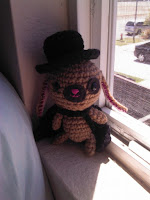
  • Top hats! ... Okay, did you guys happen to notice on my previous post that a number of things I've made include hats? This is the book I learned that pattern from. I no longer use the pattern as is described because there are points in her descriptions that just confuse me. But I did simplify it some, and I make little hats for my toys constantly.
  • Hair. Oh. Dear. GAWD. You guys... have you ever tried making a yarn wig for your toys? It is surprisingly easy! Well... Straightforward, anyway. I learned the technique in this book and bastardized it to fit my purposes. But you gotta start somewhere, and this is as good a place as any!
If I might draw your
attention to Thurston's
Hat of Mystery...
Did you notice TechGal's full
head of hair, perchance?
There are many techniques contained within this book that will help you make your own little critters, even if you don't want them to look anything like Christen Haden's stuff. So, is this my absolute favorite crochet book EVER?! ... No. But it's good, and I would recommend it if you have at least a little experience. And if you have no previous experience crocheting, you'll probably still enjoy it. Just be mindful that you may have one or two more frustrating experiences with it than if you started elsewhere. Enjoy!

Quick note! 
Sorry for not having any new pictures to demonstrate my work as it pertains to this specific book. As it turns out, I've given away the little creepers I made from these patterns without taking their pictures. (I've done that a lot.) And while I do use patterns from here regularly, they're more of the little trimmings rather than the full critters. 

Wednesday, October 14, 2015

The Immortal Circus: Act Two (Cirque des Immortels, #2)The Immortal Circus: Act Two by A.R. Kahler

My rating: 2 of 5 stars


The Immortal Circus: Act One left me with so many unanswered questions and such a dizzying cliffhanger that despite my annoyances I went right ahead and read Act Two. To be fair, this was likely due to my already having downloaded the series and having the second book readily available more than needing to answer those burning questions. In any case, The Immortal Circus: Act Two was marginally better.

In this continuation we find out more about Vivienne's past through many detailed flashbacks. I enjoyed these, as they were the only bits of the book where I could get any actual information about what was going on. With her powers starting to spiral out of control, Vivienne and her now "boyfriend" Kingston go on a vacation to return to her home where hopefully they can find the reset button and fix the mess they're in. In this book, Viv pretends as much as possible that the events of the first book didn't happen: no murders, demons, or wars occurred. The important thing now is for her to get her memory back! Little do she and Kingston know that their ringleader, master, and fae queen Mab has been planning for every possible thing that could happen and they will only get screwed over some more; all according to Mab's plan. Vivienne still emotes little or not at all, and she is still constantly getting jerked around. Her romance with Kingston remains nonexistent, no matter how much she tries to remind us that they are an official couple, and more characters who were supposed to be "normal" before are now discovering they have magic powers! We don't really see any of these, but supposedly they exist.

Meanwhile, I was finally desensitized to the pain of the first person narrative or A. R. Kahler got better at writing it. Either way, this book wasn't such a chore to get through. Kahler's descriptions of the circus, the magic, and the backgrounds are still fantastic. The characters didn't become more complex, though. There were times we added devil horns and fiendish mustaches to some of our cardboard cutouts, but that's about as complex as they got. The plot crept forward briefly. I started reading the third book, but I don't think I'll finish it. I can't describe how much I wanted to like this series, but without character development this is all just fluff. Fluff gets boring after a while.


View all my reviews

Thursday, October 8, 2015

The Immortal Circus by A.R. Kahler

The Immortal Circus (Cirque des Immortels, #1)The Immortal Circus by A.R. Kahler
My rating: 2 of 5 stars

I have conflicting feelings regarding this book. So conflicting that I changed my rating of it at least three times within the last several days, though it stayed well within the "I didn't HATE it, I just didn't like it" range. It was okay.

I finished reading it, and I read the second one, and now I'm actually reading the final book in the series, so you might think to yourself, "Well, you must have liked it!" Let's be clear: it was readable, although painful to get through at times. It is written in that style that is seldom done well: the first person present narrative. It was not done well. The main character is practically a blank slate throughout the book that you can project your own feelings of confusion at. She typically has little to add to the story, despite the fact that it's supposed to be all about her. It contained more than a few cliches, such as: main character has amnesia, main character running away from her past, characters being described as "perfect" or "sexy" with few additional details so you can imprint whatever you want on them, etc. Probably the most annoying part of the book is that you are attached to the narrator and the narrator knows little about what's going on. Hence, the reader is attached to a whiny, untalented, unremarkable girl somewhere between the ages of 16 and 21 who is as focused (if not more so) on having the hots for the magician as she is on the inexplicable murders happening within a circus where everyone is supposed to be immortal. Did I mention that Vivienne, our heroine, hardly emotes except to moon over her magician? I mean it. People are dying, she's being hit over the head with magic, she discovers that she and most others at the circus have magic powers, but whatever. It's just Tuesday.

"This book sounds TERRIBLE! Why would you say it's okay?"
It's like a pumpkin spice latte: good in theory, but a gastric disaster in execution. The concept is what drew me in to begin with. I was lured in by the promise of an impossible murder mystery in an immortal circus surrounded by fairies. Sadly, the execution was lacking. The best parts of this book were the backgrounds and background characters. The fairies, the magic, the settings were all fantastic. A.R. Kahler can actually give some decent descriptions about the circus, the fairies, and how the fairies are generally going to be dicks to all humans. They're dark, and I found that wonderful. I wanted the story to be more about them. And that is why I found this book to be only "okay" instead of dreadful or enjoyable. I obtained enough glimpses of the dark, deadly, dickish fairies to keep me engaged until the end of the book, though just barely.

View all my reviews