Showing posts with label home. Show all posts

Friday, January 20, 2017

Magnificent Mosaics: Stained Glass Coloring Book


I'm going to stop pretending that eventually I'll stop reviewing coloring books. A while back, I think it was reasonable to assume that I could stop reviewing coloring books because I generally don't buy them! This, however, was a special circumstance!— it was on sale, and I'd never seen a stained glass coloring book before!

So what's so cool about it?
This book is all intricate mosaic patterns on transparent coloring paper that allows light to filter through it, mimicking stained glass. There are fifteen images included in Magnificent Mosaics: Stained Glass Coloring Book, and the pages are perforated so that you can stick your finished artwork on your windows and enjoy the pretty colors!

If you are as hopelessly addicted to coloring books as I am, you've likely noticed that most adult coloring books have faith that you will:

  1. Finish coloring an entire image or five before you die.
  2. Color it well enough to want to frame it.
  3. Frame it.
I don't know about you guys, but for all the coloring books I now own— more than one, but fewer than all of them— I've yet to completely finish coloring even a single image. Furthermore, even if I did finish an image, I don't know that I would like my work well enough to consider framing it. So while I appreciate that books have that level of confidence in me, framing will probably never happen. Meanwhile, Magnificent Mosaics: Stained Glass Coloring Book says: "Stick this in your window! Enjoy the light show!" And I can completely get behind that! So I think I have a better chance at actually finishing some of these images, since all they require of me when I'm done is a window and some tape.

Find me on Amazon!
If there is one thing that I am not entirely pleased with in regards to this book, it is that there are only fifteen images. For a $7.99 coloring book, I would have liked to get more images. Of course, if this were a normal coloring book and not a stained glass coloring book, I probably would have. So keep that in mind: what you lose in images to color, you gain in a different kind of paper and a different coloring experience. If you're not a fan of stained glass, but you like mosaics, I encourage you to try Magnificent Mosaics instead! This older coloring book is less expensive than its newer, stained glass version and contains 30 images for you to zen out with. The stained glass coloring book actually consists of excerpts from this older Magnificent Mosaics, but on that transparent paper. Or get both of them! Either way, I recommend them: I liked the artwork, the transparent paper is fun, and if you never finish an image you will still have fun trying.

Saturday, October 8, 2016

The Food Lovers Make it Paleo Cookbook

You see? I'm not the only one who thinks so!
Is there any word in the English language more frightening than "Diet?" Especially at this time of the year, when one of our greatest pleasures as Americans is to dress up in costumes all month long and stuff our faces full of delicious sugar? Perhaps. But "diet" remains one of my least favorite words, capable of causing haunting nightmares.

Privileged much?
Yes, but that's not what this post is about. It's about a cookbook that doesn't even make mention of the word "diet," which is one of the reasons I like it so much.

That was an unexpected turnaround!
Yes, thank you. Before we move on to the actual book review, you should know something about me: I don't really cook. I know a few recipes by heart— they're simple, straightforward, and will feed me for the better part of a week with only thirty to forty minutes of effort on my part. I like these recipes because I am a lazy cook. I've also already practiced eating Paleo(ish) before. It is also fairly straightforward, but even a lazy cook gets tired of eating the exact same thing on a daily basis.


The Food Lovers Make it Paleo cookbook contains "over 200 grain-free recipes for any occasion." Not all of them are made with the lazy cook in mind, but I'm happy to report that not one of the recipes made me think I needed to be an accomplished chef to make them. The recipes are formatted so that— at a glance— you can see: the ingredients you need, the process to make them, difficulty, estimated prep and cook time, and how many people it serves.

As with many cookbooks, the recipes are separated into different meals (breakfasts, appetizers, entrĂ©es), as well as side dishes, sauces, and treats. This makes figuring out what you want to eat the following day especially simple. Feel like changing up your breakfast routine? Go to the breakfast section! Is your favorite thing in the world chicken but you want to change up the side dishes for dinner? Go to the side dishes section! What if you tried one of the recipes, and maybe you weren't a fan of most of it, but hot DAMN! That sauce that you had on it was the best thing ever and you could drink it by the gallon? The sauces are in a separate section. You can find most things quickly in this book.

What if nothing in my kitchen is set up for eating like a caveman?
That's okay! If you think you'll be making many of these recipes, it may be a good idea to rethink what you stock in your cabinets. None of the ingredients needed are necessarily difficult to find, and there is a chapter devoted to "the Paleo Kitchen." Therein you will find what authors Staley and Mason recommend as key ingredients to keep handy in your kitchen, tools to make your life easier, and "basic cooking tips" (for people like me who know only the most basic anatomy of the stove).

But how will I know what's good to eat? Isn't that what REALLY matters?!
Generally we're not supposed to eat with our eyes, but since I cannot know what a recipe tastes like until I make it, I go by the pictures. Make it Paleo is beautifully illustrated, and everything looks delicious. And if you're not sure what to pair together for an amazing meal, well they've got you covered there also with some suggested menus for special occasions!

You might like this book if:

  1. You're already a fan of the paleo lifestyle and you want additional recipes
  2. You're looking to improve your health by cutting out some common processed ingredients.
  3. You like food.
Sorry guys, I really can't think of a reason you might not like this book. Unless you're completely vegetarian or vegan, in which case half of it might not apply to you.

Saturday, August 20, 2016

What Alice Forgot (Spoilers: It was a lot)


Alice forgot an entire decade: the birth and lives of her three children, divorce proceedings, and the existence of her best friend. Meanwhile, I was beating myself up because I forgot when, exactly, I picked up this book; I'm fairly certain it was within the last two weeks. I read it over the course of two days, and I daresay they were two days well spent.

The story begins with Alice dreaming of cream cheese. Why not? Dreams are typically pretty weird. Alice Love is 29 years old, completely enamored with her husband, and pregnant with their first child. Or at least, so she believes when she wakes up from the cream cheese dream. But the reality is that Alice is 39 years old. She is on the floor of the gym wearing clothes she would swear are not hers. And what is she doing at the gym anyway? She hates exercising!

Oh no...
Oh Yes: It's an amnesia book.

Gasp of Horror!
As luck would have it, it isn't as cheesy as a soap opera; we can all rest a little easier. The story actually reads a bit like a detective novel: a heart-squishing kind of detective novel. Even my little black heart was momentarily touched as Alice tries to find the truth: if she and her husband were so happy, how could they be getting a divorce now? Did ten years turn her into an unlovable bitch where the most important people are concerned? Did he cheat on her? Why is her sister, who was always her best friend, so distant now? What did a decade do? As previously mentioned: it did a lot. The story goes back and forth primarily between Alice's perspective and her sister Elizabeth's journal/letters to her therapist. Alice's amnesia is a sort of catalyst for everyone to examine their relationships and who they've lost touch with over the years.

This may have been silly of me, but I read this as a horror novel for a while.

You ARE silly.
I know, but it was scary, because I can relate to the younger version of the characters. I was telling my husband how horrifying it is that in ten years we might have accrued all these little hurts and resentments that might make us hate each other, which is basically what was happening to these characters. And then he said something that made it all better. "Clearly, they never had the poop talk." Because if you can discuss your bowel movements with your partner, you can talk your way through anything. And those petty hurts you're bent out of shape over? You gotta let that shit go. In summary, the characters in this book are emotionally constipated, and Alice's amnesia is the laxative they needed. Once she gets in touch with her younger self, she remembers that some of the stuff she's wound up in really isn't so important after all. And she lets it go. So far, this book may seem like a bit of a downer. For those of you who cannot read something unless it has a happy ending, you can add this book to your list of things to read. You're safe.

Overall, I enjoyed this story and would recommend it to most people. Since much of it centers around what it means to be a wife, a mother, and reproductive issues, I don't expect men would care too much for it, but they might gain some insights anyway. The only thing that I found particularly weird about it didn't even have anything to do with the story, but with the book itself. Right after you're finished reading, there is a page toward the end that includes a list of discussion questions. I found the story compelling enough that I asked myself questions as we went along: What my life was like 10 years ago versus what I think it will be like 10 years from now, what relationships I lost to distance or pettiness, how the different character perspectives added to the story, etc. Well, I'm not sure if Liane Moriarty expects her book to be taught in college, or discussed in book clubs and she just has no faith in her readers' ability to think critically, because I found the inclusion of discussion questions to be unnecessary and even pretentious. Other than that, I don't think you'll regret reading What Alice Forgot.

Tuesday, August 2, 2016

The Rooftop Growing Guide


Another gardening book?
Yep! I'm pretending to be a Sim, in the hopes that reading enough books about a subject will transform me into a master gardener before I ever touch dirt. Remember, I'm also working from a disadvantage: ignorance in gardening presents itself first as a black thumb. At least I'm hoping it's my ignorance of proper gardening techniques that murders the plants, and not a genetic predisposition to screwing up green spaces. 

Originally, I ordered this book to help me with my container garden, because obviously a rooftop garden means a container garden on the roof. At least, that's what I thought. I was pleasantly surprised to learn that is not always the case! It should've been obvious to me from the title and picture on the cover, but Annie Novak meant nothing so small as a container when she wrote this book. After all, look at the flat roof on that building and the size of the plants atop it!

I think this book is aimed primarily at people living in dense urban zones where there aren't many green spaces. Basically, since real estate is scarce and high cost, they instead turn to their roofs. It makes sense, really. On the roof of a building, you don't have to worry as much about whether your building or the next is perpetually casting shade over your plants, or if you have enough space in your tiny backyard to plant all you want. What if you want to plant something in particular, but the soil conditions in your area are not optimal for your new green darling? Rooftop gardening is the perfect opportunity to create your own optimal growing settings.

If only it were as easy as seeds + dirt + water. My strawberries
refuse to grow, and it makes me sad!
Before you get to thinking that it's as easy as throwing some dirt on your roof and some seeds on top of that, let me just tell you: No, not quite. It is still gardening, but with a few twists! These include whether or not your roof can even properly support a garden! Let's face it, buildings are made to sustain a certain amount of weight. Soil, plants with their roots, and especially the water intended to make everything grow, is likely to add weight the building may not support. That issue is fairly straightforward, but also stop to think about how you'll irrigate your rooftop garden, or how the roof microclimate will affect your plants! Yeah, I went there: I said "microclimate." No, rooftop gardening is decidedly not as straightforward as tossing some dirt and seeds up there and hoping for the best.

At this point, you're probably wishing I'd just get to the point and tell you how it would benefit you to get this book. First and foremost: Do you have a flat roof to grow things on? If you do, you will find this book interesting and helpful, whether you intend to have a small herb garden or a full-blown farm. The writing is engaging, and Novak has anecdotes from other rooftop gardeners to augment her own knowledge. Chances are that if you have a question, she will likely address it or has some other resource to offer. She covers topics ranging from assessing your rooftop —can I even grow here?— and pests, to choosing whether to grow in containers or greenhouses, or green roofs. And of course, there is also the ever present chapter on planning your garden. Yes, if I've learned anything from all these gardening books, it's that besides remembering to actually water your plants, the most important thing you can do is to plan your garden.

However, since I do not have a flat roof on which to grow things, I found The Rooftop Growing Guide to be theoretically interesting, but ultimately impractical. A more general gardening book would have suited me better, but that is not Annie Novak's fault. So if you have a flat roof, I absolutely recommend this book. And if you don't, you might still find it interesting to read.

I received a complimentary copy of The Rooftop Growing Guide from Blogging for Books in exchange for a fair and honest review.

Sunday, June 26, 2016

Stitch 'N Bitch: The Knitter's Handbook


I suck at knitting. No matter how hard I try, I can't seem to go beyond the absolute basics— straight knitting needles and square shapes. That isn't for lack of trying, or lack of being informed, though. After falling in love with Stitch 'N Bitch: The Happy Hooker, I was sure that Debbie Stoller's original knitting handbook would be the perfect way to teach myself to knit! I wasn't exactly wrong... But my increased knitting knowledge has not helped me complete complex projects. And why? Because if this book has taught me anything, it's that I need five times the tools and a blood sacrifice to achieve what I could with one crochet hook. But let's pretend for a minute that you're already a knitter and are used to these blood sacrifices.

I keep sheep for this express purpose!
I would keep sheep for the eventual yarn but if you want to play it biblical and keep them handy for blood sacrifices, that's cool too, I guess. You do you.

So, you're already a knitter: Jump into the deep end with 40 knitting projects of varying difficulty! They range from quick scarves and hats to marathon-style, focus-heavy sweaters and blankets. There is even a pattern for a cat bed in here. I find that one amusingly pointless, since my cat would prefer to sleep on a pile of clean clothes or on my face over her own bed any day.

Tools of the trade: Crochet hooks (top left), circular knitting needles
(top right), straight knitting needles, and resource book.
The only thing I found frustrating (and this has more to do with knitting as a craft than with the book) is that I wanted to make some of these hats and they required two or three different types of needles. That means I would need to have between five and seven needles for one project. Is that Debbie Stoller's fault? Or the fault of the designers featured in this book? Absolutely not! I appreciate that they let me know beforehand so I didn't waste my time starting a project that I'd never finish for lack of owning every damn knitting tool on the market. But we're pretending you're already a knitter, so maybe you own all that already. Congratulations! These are some cool-looking projects! My favorites are the different bags. As I was flipping through the book again today, I got the itch to make all of them: backpacks, purses, and totes. They look complex, but are fairly straightforward to make. All patterns contained herein include a briefing on necessary materials, the gauge you should be aiming for, finished size, and best yarns to use. All patterns were screened by a technical editor as well, so they're pretty much guaranteed to work. I certainly haven't found any technical problems with them yet.

What if I'm a complete beginner?
Fear not! This is still a fantastic, beginner-friendly resource book. The beginning half of the book is dedicated to teaching you knitting basics and some additional niceties. One of the things I love about the Stitch 'N Bitch series is how in-depth it goes. While some books will attempt to teach you as they go along with the pattern, Stoller does it all up-front so you can try tackling those tougher projects after some reading. Even if you've never held a pair of knitting needles and yarn, she explains the process in a clear and entertaining manner. You could, of course, just read the portion on how to start your project and jump into the patterns. You can use this book however you damn well please. But I think you'll have an easier time if you actually read some of it first.

You know what else is pretty cool about this? Stoller mentions several different resources within the book to further educate yourself on the subject of knitting! She mentions multiple books, magazines, and websites for additional reading. If you want to shop for fancy yarns at discount prices, she points out the best way to search for them. This book is full of handy tips and tricks for getting the most out of your knitting experience. If you're interested in the craft, I highly recommend checking this book out. It can only make your life— at least the knitting portion of it— easier. Good luck, and happy knitting!

Monday, June 6, 2016

Challenge Mode: ON

As you may recall from a previous post (if you're keeping track), I mentioned that I will be heading to StocktonCon on August 20th and 21st. Last year, I did very well at this convention, so I have high hopes of repeating that success this year! Of course, that'll never happen unless I set high goals, sooooo...

Behold: My goal!

It's a box...
Yes, an empty box! And, to be fair, it isn't even all that big. My goal is to fill this box twice before StocktonCon with all sorts of crochet goodies. I'm thinking an assortment of hats, gloves, and amigurumi ought to do it. I've already gotten started, but items will make it into the box as they are completed (all loose tails tucked in, faces made, ready to go home). I have project ADHD, hence why this box is still empty. I probably have five jellyfish amigurumi and multiple sets of gloves that are in "finishing stages" limbo.

Okay, given how long it takes to crochet some of these projects, I guess that's a challenge...
The bag of poly-fill is bigger than
the goal box...
Actually, that isn't the challenge. Seeing as how I've got two and a half months to work on this, filling the box only twice is a smart goal. The challenge is to make things using only my current, accessible stash of supplies. Because, you see, I have so many more supplies besides what is pictured, but some of them are currently in storage; and they will not come out until I've finished what I have on hand. So there lies my challenge: emptying out the bags and bins of yarn I can reach by convention-time in August. Expect more pictures of my progress as I fill up the box! I'll be sure to have some completed projects in there by next week! Oh, and if you have ideas on how to make this additionally challenging, or have requests— for toys, hats, or a particular style of gloves— that you'd like to see in there, let me know by leaving a comment!

Tuesday, May 24, 2016

Stitch 'N Bitch: The Happy Hooker

Find me on Amazon in digital format!
My love of this book—

"Love," is it?
—begins with the title. Which, unfortunately, does not lend itself to my usual introductory snark, so I'll be skipping that today. Instead, let me just tell you about one of my favorite crochet books!

The Happy Hooker was my introduction to the Stitch 'N Bitch series by Debbie Stoller, as well as my reintroduction to crochet after many years of not practicing. I came across this title while perusing the craft section at Barnes & Noble many years ago.

Like a crack addict in the crack section of the store? What a surprise.
My name is Ly and I am a yarnaholic. My stash is so great that several months of dedicated crocheting have done little to reduce it. That being said, it is not for lack of trying or lack of patterns. If anything, maybe I have too many options. Debbie Stoller put together a collection of patterns from various designers that range from hats and scarves to purses and swimwear; an entire wardrobe just begging to be made. Not that I'm insinuating there are only patterns for clothes and accessories here. The book also includes: an outdoor rug, amigurumi, bunny slippers, afghans, and some baby things.

Happy Hooker is split in two parts. The first is the best and most comprehensive "how to hook" section of a crochet book that I have ever encountered. Even if I got bored of all of the patterns in this book— which is unlikely— I would hang on to it for use as a reference guide. If you are a beginning or returning crocheter and you're rusty on your basics, this book will whip you back into shape in no time flat!

Kinky hook(er), is it?
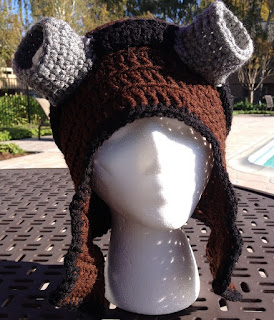
Creativity and knowledge of a few basic shapes turn a
basic beanie pattern into something extra special
More like best hook for buying and keeping a book! Most craft books will give you a crash course on the basics you'll need to know to reproduce the patterns therein, but this... This is comprehensive! I find that I remember things best when I understand how they work, instead of memorizing that they just work a certain way. Stoller explains the "hows" and "whys" of crochet, as well as delves into some of the history and the differences between crochet and knitting. The result is that after reading this, and a little practice with the patterns, I was able to start figuring out patterns on my own. This book has even helped me with patterns in other books. Do you have any idea how annoying it is to start a project, follow the directions exactly, and find that at the end, the directions didn't make sense for the thing you're trying to produce?

Is it awful?
It IS awful! But with a bit of knowledge, like that provided in The Happy Hooker, you may be able to figure out what went wrong and fix it yourself! I certainly have. I cannot stress this enough: this will help you break down patterns into their basic components. No pattern will be so complicated that you can't ultimately make it your bitch. That's how this book will make you feel. From how to hold your hook, to finishing your project, and everything in between: Stoller explains it all.
Part of making a pattern your bitch is making things up
when you can't find a pattern for it at all.

What about the patterns?
Part two of The Happy Hooker is broken up further into sections for: scarves and shawls, hats, bags, "spring and summer" (clothes), "Fall and winter" (sweaters), accessories, and "home, gifts and baby." The patterns are by different designers and I've yet to encounter one that didn't work the way it's supposed to. In other words, someone actually made all of the projects presented and edited the patterns accordingly so there are no mistakes.

You say that like not all editors earn their keep...
Because they don't always earn their keep. That is yet another point in this book's favor. Each pattern includes some basic information about the project: the finished size, different sizes (small, medium, large), materials, extras you may need, and special stitches you'll be learning. They have recommendations for the yarn you use or how to adapt the pattern if you decide to go with something else. I believe the patterns for scarves, shawls, hats, bags, and home things are generally the easiest to make, since gauge— though always given— is not always as important to adhere to. However, once you've gained some confidence in your hooking abilities, I recommend branching out and making yourself some clothes!

So basically, what you're saying is... You love this book.
YES! Stitch 'N Bitch: The Happy Hooker is my constant crochet companion. I highly recommend it to everyone, whether beginner or master hooker. I am an extremely happy hooker; you can be too!

A note about format:
I bought myself a Kindle a few months ago after years of believing that a digital format could never compare with the touch and smell of a paperback. While I sometimes miss the smell of paperbacks, I'm happy to report that my Kindle Paperwhite at least feels like a book in my hands, albeit much lighter. Obviously, whether you decide to go digital or physical with your books depends entirely on your personal preference but I do want to point something out. With craft books, there will be times when you'll want to check the reference section at the front of the book for help on something while you're working on a project and I (personally) think physical copies are the way to go in such cases. Just putting my opinion all over this blog, y'know. I recommend this book and —if you have the space for it on your bookshelf— I recommend getting a physical copy. That being said, I hope you enjoyed the review!